Slide 1 of 1 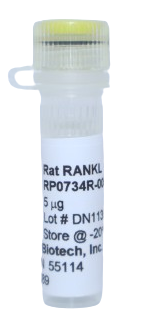
Rat RANKL (TNFSF11) Recombinant Protein
- Catalog Number:
- RP0734R
- Availability:
- In stock
- Application:
- Cell Culture, Control, ELISA, ELISpot Control, Western Blot Control
- 100% Homology:
- Rattus norvegicus (Norway rat)
 Powered by Bioz
 - Rat RANKL (TNFSF11) (catalog RP0734R) is a yeast-derived cytokine supplied lyophilized without carrier protein in 10% trehalose; it has no affinity tags and is naturally endotoxin-free, and should be reconstituted in sterile PBS that contains at least 0.1% carrier protein. The protein is ~19.8 kDa, 178 amino acids long (full sequence provided), and >98% pure by SDS-PAGE, with 100% amino-acid homology to rat. Store at -20°C (stable up to twelve months from date of receipt; working aliquots with carrier protein stable ~3 months) and avoid repeated freeze/thaw cycles. Product origin is the USA. It is commonly used to study RANKL/TNFSF11 signaling and bone and immune biology (including osteoclast differentiation and activation); typical experimental uses include cell-culture stimulation and dosing studies, differentiation assays, ELISA and neutralization assays, flow-cytometry and Western blot controls, and antibody generation/validation. Kingfisher Biotech products are supplied for research applications and are not intended for medicinal, diagnostic, or therapeutic use.
| Amino Acid Sequence | FSGVPAMMEG SWLDVARRGK PEAQPFAHLT INAANIPSGS HKVSLSSWYH DRGWAKISNM TLSNGKLRVN QDGFYYLYAN ICFRHHETSG SVPADYLQLM VYVVKTSIKI PSSHNLMKGG STKNWSGNSE FHFYSINVGG FFKLRAGEEI SVQVSNPSLL DPDQDATYFG AFKVQDID (178) |
| Endotoxin | Naturally endotoxin-free |
| Form | Lyophilized |
| Storage Conditions | -20°C |
| Molecular Weight | 19.8 kDa |
| Purity | >98% as visualized by SDS-PAGE analysis. |
| Expression System | Yeast |
| Form | Lyophilized |
| Country Of Origin | USA |
Rat RANKL (Receptor Activator of Nuclear Factor κB Ligand, also known as TNFSF11, TRANCE, or OPGL) is a cytokine belonging to the tumor necrosis factor (TNF) superfamily, which includes related ligands such as TNF-α, Fas ligand (FasL), CD40 ligand (CD40L), and TRAIL that regulate immune signaling, apoptosis, and cellular differentiation. In rats (Rattus norvegicus), RANKL is expressed primarily by osteoblasts, bone marrow stromal cells, activated T lymphocytes, and other immune cells, where it plays a central role in bone remodeling and immune system regulation. RANKL functions by binding to its receptor RANK (receptor activator of NF-κB) on osteoclast precursors and mature osteoclasts, activating intracellular signaling pathways including NF-κB, MAPK, and NFATc1, which promote osteoclast differentiation, activation, and bone resorption. The activity of RANKL is tightly regulated by osteoprotegerin (OPG, TNFRSF11B), a soluble decoy receptor that binds RANKL and prevents its interaction with RANK, thereby maintaining balanced bone turnover. In rats, the RANKL–RANK–OPG signaling axis is widely studied in experimental models of osteoporosis, bone fracture healing, arthritis, and bone metastasis, where dysregulated RANKL signaling contributes to increased osteoclast activity and pathological bone loss. Because rats are commonly used in orthopedic, metabolic bone disease, and pharmacological research, characterization of rat RANKL has contributed significantly to understanding osteoclast biology, skeletal remodeling, and therapeutic strategies targeting bone resorption.
Citations
Please choose a size to see price
RELATED MEDIA
