Slide 1 of 1 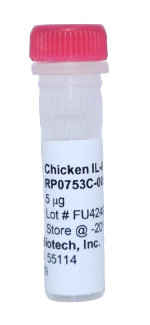
Chicken IL-8 Recombinant Protein
- Catalog Number:
- RP0753C
- Availability:
- In stock
- Application:
- Cell Culture, Control, ELISA, ELISpot Control, Western Blot Control
- 100% Homology:
- Gallus gallus (chicken), Gallus lafayettii (Ceylon junglefowl), Gallus sonneratii (gray junglefowl), Numida meleagris (helmeted guineafowl), Phasianus colchicus (Ring-necked pheasant)
 Powered by Bioz
 - Chicken IL-8 (CXCL8) (catalog RP0753C) is a yeast-derived chemokine supplied lyophilized without carrier protein in 10% trehalose; it has no affinity tags and is naturally endotoxin-free, and should be reconstituted in sterile PBS that contains at least 0.1% carrier protein. The protein is ~9.5 kDa, 87 amino acids long (full sequence provided), and >98% pure by SDS-PAGE, with 100% amino-acid homology to chicken, guineafowl, junglefowl, and pheasant. Store at -20°C (stable up to twelve months from date of receipt; working aliquots with carrier protein stable ~3 months) and avoid repeated freeze/thaw cycles. Product origin is the USA. It is commonly used to study IL-8/CXCL8 signaling and chemotaxis (including recruitment and activation of neutrophils); typical experimental uses include cell-culture stimulation and migration assays, chemotaxis and signaling studies, ELISA and neutralization assays, flow-cytometry and Western blot controls, and antibody generation/validation. Kingfisher Biotech products are supplied for research applications and are not intended for medicinal, diagnostic, or therapeutic use.
| Amino Acid Sequence | ALSQGRTLVK MGNELRCQCI STHSKFIHPK SIQDVKLTPS GPHCKNVEII ATLKDGREVC LDPTAPWVQL IVKALMAKAQ LNSDAPL (87) |
| Endotoxin | Naturally endotoxin-free |
| Form | Lyophilized |
| Storage Conditions | -20°C |
| Molecular Weight | 9.5 kDa |
| Purity | >98% as visualized by SDS-PAGE analysis. |
| Expression System | Yeast |
| Form | Lyophilized |
| Country Of Origin | USA |
Chicken Interleukin-8 (IL-8), also referred to as CXCLi2 (and closely related to CXCLi1 in avian species), is a key pro-inflammatory chemokine that regulates heterophil chemotaxis and activation in chickens (Gallus gallus). Functionally analogous to mammalian IL-8, chicken IL-8 is produced by macrophages, epithelial cells, and other immune cells in response to bacterial, viral, and parasitic infections, and signals through CXCR1- and CXCR2-like receptors to promote recruitment of heterophils—the avian equivalent of neutrophils—to sites of infection or tissue damage. IL-8 is rapidly upregulated during economically significant diseases such as avian influenza, Newcastle disease, infectious bronchitis, Salmonella infection, Eimeria (coccidiosis), and necrotic enteritis, where it plays a central role in early innate immune defense but can also contribute to inflammatory tissue pathology if dysregulated. Elevated IL-8 expression in respiratory and intestinal tissues serves as a valuable biomarker of mucosal immune activation and disease severity in poultry. In research settings, chickens are established animal models for avian influenza virus pathogenesis, Salmonella enterica colonization and foodborne transmission studies, Eimeria-induced intestinal inflammation models, Campylobacter infection, and vaccine development platforms, as well as developmental immunology research due to the accessibility of the avian embryo. Characterization of IL-8 in these specific models enhances understanding of chemokine-driven heterophil recruitment, mucosal immune defense, inflammatory regulation, and vaccine-induced protection, providing comparative insight into neutrophil-mediated immunity relevant to both veterinary medicine and human infectious disease research.
Citations
Please choose a size to see price
RELATED MEDIA
