Slide 1 of 1 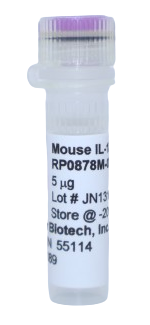
Mouse IL-18 Recombinant Protein
- Catalog Number:
- RP0878M
- Availability:
- In stock
- Application:
- Cell Culture, Control, ELISA, ELISpot Control, Western Blot Control
- 100% Homology:
- Mus musculus (house mouse)
 Powered by Bioz
 - Mouse IL-18 (catalog RP0878M) is a yeast-derived cytokine supplied lyophilized without carrier protein in 10% trehalose; it has no affinity tags and is naturally endotoxin-free, and should be reconstituted in sterile PBS that contains at least 0.1% carrier protein. The protein is ~18.1 kDa, 157 amino acids long (full sequence provided), and >98% pure by SDS-PAGE, with 100% amino-acid homology to house mouse. Store at -20°C (stable up to twelve months from date of receipt; working aliquots with carrier protein stable ~3 months) and avoid repeated freeze/thaw cycles. Product origin is the USA. It is commonly used to study IL-18 signaling and inflammatory and immune responses (including induction of IFN-γ production and activation of NK and T cells); typical experimental uses include cell-culture stimulation and dosing studies, cytokine signaling assays, ELISA and neutralization assays, flow-cytometry and Western blot controls, and antibody generation/validation. Kingfisher Biotech products are supplied for research applications and are not intended for medicinal, diagnostic, or therapeutic use.
| Amino Acid Sequence | NFGRLHCTTA VIRNINDQVL FVDKRQPVFE DMTDIDQSAS EPQTRLIIYM YKDSEVRGLA VTLSVKDSKM STLSCKNKII SFEEMDPPEN IDDIQSDLIF FQKRVPGHNK MEFESSLYEG HFLACQKEDD AFKLILKKKD ENGDKSVMFT LTNLHQS (157) |
| Endotoxin | Naturally endotoxin-free |
| Form | Lyophilized |
| Storage Conditions | -20°C |
| Molecular Weight | 18.1 kDa |
| Purity | >98% as visualized by SDS-PAGE analysis. |
| Expression System | Yeast |
| Form | Lyophilized |
| Country Of Origin | USA |
Mouse IL-18 (Interleukin-18) is a pro-inflammatory cytokine belonging to the IL-1 family that plays a central role in innate and adaptive immune responses in mice (Mus musculus). IL-18 is produced primarily by monocytes, macrophages, dendritic cells, epithelial cells, and other tissue-resident cells as an inactive precursor that requires cleavage by caspase-1 following inflammasome activation to become biologically active. Once activated, IL-18 stimulates production of interferon-γ (IFN-γ) by CD4⁺ and CD8⁺ T cells as well as natural killer (NK) cells, thereby promoting Th1-type immune responses and enhancing cell-mediated immunity against intracellular pathogens. In healthy mice, basal IL-18 expression is generally low but increases during bacterial, viral, and parasitic infections, as well as during inflammatory stimulation. Mouse IL-18 has been extensively studied in models of sepsis, colitis, experimental autoimmune encephalomyelitis (EAE), arthritis, metabolic inflammation, and tumor immunity. Depending on context, IL-18 can contribute to protective immunity or to pathological inflammation. In biomedical research, mouse IL-18 serves as a key marker of inflammasome activation and Th1-driven immune responses and is widely used to investigate mechanisms of innate immune signaling and inflammatory disease.
Citations
Please choose a size to see price
RELATED MEDIA
