Slide 1 of 1 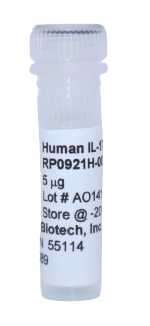
Human IL-17A Recombinant Protein
- Catalog Number:
- RP0921H
- Availability:
- In stock
- Application:
- Cell Culture, Control, ELISA, ELISpot Control, Western Blot Control
- 100% Homology:
- Homo sapiens (human)
 Powered by Bioz
 - Human IL-17A (catalog RP0921H) is a yeast-derived cytokine supplied lyophilized without carrier protein in 10% trehalose; it has no affinity tags and is naturally endotoxin-free, and should be reconstituted in sterile PBS that contains at least 0.1% carrier protein. The protein is ~15.1 kDa, 132 amino acids long (full sequence provided), and >98% pure by SDS-PAGE, with 100% amino-acid homology to human. Store at -20°C (stable up to twelve months from date of receipt; working aliquots with carrier protein stable ~3 months) and avoid repeated freeze/thaw cycles. Product origin is the USA. It is commonly used to study IL-17A signaling and inflammatory responses (including regulation of cytokine production and neutrophil recruitment); typical experimental uses include cell-culture stimulation and dosing studies, cytokine signaling assays, ELISA and neutralization assays, flow-cytometry and Western blot controls, and antibody generation/validation. Kingfisher Biotech products are supplied for research applications and are not intended for medicinal, diagnostic, or therapeutic use.
| Amino Acid Sequence | GITIPRNPGC PNSEDKNFPR TVMVNLNIHN RNTNTNPKRS SDYYNRSTSP WNLHRNEDPE RYPSVIWEAK CRHLGCINAD GNVDYHMNSV PIQQEILVLR REPPHCPNSF RLEKILVSVG CTCVTPIVHH VA (132) |
| Endotoxin | Naturally endotoxin-free |
| Form | Lyophilized |
| Storage Conditions | -20°C |
| Molecular Weight | 15.1 kDa |
| Purity | >98% as visualized by SDS-PAGE analysis. |
| Expression System | Yeast |
| Form | Lyophilized |
| Country Of Origin | USA |
Human IL-17A (Interleukin-17A) is a pro-inflammatory cytokine belonging to the IL-17 family that plays a central role in host defense and immune-mediated inflammation. IL-17A is produced primarily by Th17 CD4⁺ T cells, as well as by γδ T cells, innate lymphoid cells (ILC3s), and other activated lymphocyte subsets in response to microbial infection and inflammatory stimuli. It acts on epithelial, endothelial, and stromal cells to induce the expression of pro-inflammatory cytokines (e.g., IL-6, TNF-α), chemokines (such as CXCL8/IL-8), and antimicrobial peptides, thereby promoting neutrophil recruitment and enhancing mucosal and barrier immunity. In healthy individuals, basal IL-17A levels are typically low, but concentrations increase during bacterial and fungal infections, particularly at mucosal surfaces. Dysregulated IL-17A signaling has been strongly implicated in chronic inflammatory and autoimmune diseases, including psoriasis, psoriatic arthritis, ankylosing spondylitis, rheumatoid arthritis, inflammatory bowel disease, and multiple sclerosis. Targeted inhibition of IL-17A (e.g., with monoclonal antibodies such as secukinumab and ixekizumab) has demonstrated significant clinical efficacy in several of these conditions. In clinical and translational research, human IL-17A serves as a key biomarker of Th17-mediated immune activation and neutrophilic inflammation and represents an important therapeutic target in immune-mediated inflammatory disease.
Citations
Please choose a size to see price
RELATED MEDIA
