Slide 1 of 1 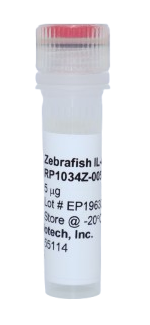
Multi-species (Zebrafish, Stickleback) IL-4 Recombinant Protein
- Catalog Number:
- RP1034Z
- Availability:
- In stock
- Application:
- Cell Culture, Control, ELISA, ELISpot Control, Western Blot Control
- 100% Homology:
- Danio rerio (zebrafish), Gasterosteus aculeatus (three-spined stickleback)
 Powered by Bioz
 - Zebrafish/Stickleback IL-4 (catalog RP1034Z) is a yeast-derived cytokine supplied lyophilized without carrier protein in 10% trehalose; it has no affinity tags and is naturally endotoxin-free, and should be reconstituted in sterile PBS that contains at least 0.1% carrier protein. The protein is ~12.4 kDa, 111 amino acids long (full sequence provided), and >98% pure by SDS-PAGE, with 100% amino-acid homology to zebrafish and three-spined stickleback. Store at -20°C (stable up to twelve months from date of receipt; working aliquots with carrier protein stable ~3 months) and avoid repeated freeze/thaw cycles. Product origin is the USA. It is commonly used to study IL-4 signaling and immune responses (including regulation of Th2-like pathways, immune-cell activation, and cytokine production); typical experimental uses include cell-culture stimulation and dosing studies, cytokine signaling assays, ELISA and neutralization assays, flow-cytometry and Western blot controls, and antibody generation/validation. Kingfisher Biotech products are supplied for research applications and are not intended for medicinal, diagnostic, or therapeutic use.
| Amino Acid Sequence | SKLKIDEILL MEIIQSVNGI LNGKGEKMDL DQFIPDIYET GHYSKKTLCQ AGMALKGKIP SRSHLQRQLN AYAAYTGTGN CSVSTSGECT MKEFLEKTKA CCHYLYSAQR T (111) |
| Endotoxin | Naturally endotoxin-free |
| Form | Lyophilized |
| Storage Conditions | -20°C |
| Molecular Weight | 12.4 kDa |
| Purity | >98% as visualized by SDS-PAGE analysis. |
| Expression System | Yeast |
| Form | Lyophilized |
| Country Of Origin | USA |
Zebrafish (Danio rerio) and Three-Spined Stickleback (Gasterosteus aculeatus) possess IL-4/13–like cytokines that are functional homologs of mammalian IL-4 and IL-13 and share highly conserved structural and functional features between these teleost species. Due to ancestral genome duplication events in ray-finned fish, both zebrafish and stickleback encode IL-4/13A and IL-4/13B paralogs, which collectively mediate type 2–like immune responses. These cytokines signal through receptor complexes homologous to IL-4Rα/IL-13R–type chains and activate STAT6-dependent pathways, promoting alternative (M2-like) macrophage polarization, modulation of pro-inflammatory cytokine production (e.g., il1b and tnfa), enhancement of epithelial barrier function, and support of tissue repair processes. In both species, IL-4/13–like cytokines are induced during helminth infection, mucosal inflammation, and tissue injury, where they contribute to immune regulation and resolution of inflammation. Zebrafish and stickleback are widely used models in immunology, evolutionary biology, and host–parasite interaction studies, and characterization of their IL-4/13–like signaling pathways provides insight into the evolutionary origins of Th2-type immunity. As conserved regulators of type 2–associated immune responses, IL-4/13–like cytokines in these species support comparative research into macrophage plasticity, mucosal immunity, and cytokine network evolution relevant to vertebrate inflammatory and allergic diseases.
Citations
Please choose a size to see price
RELATED MEDIA
