Slide 1 of 1 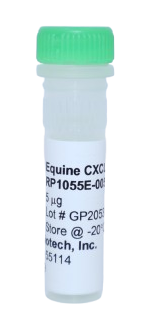
Equine CXCL13 Recombinant Protein
- Catalog Number:
- RP1055E
- Availability:
- In stock
- Application:
- Cell Culture, Control, ELISA, ELISpot Control, Western Blot Control
- 100% Homology:
- Equus caballus (horse), Equus przewalskii (Przewalski's horse)
 Powered by Bioz
 - Equine CXCL13 (catalog RP1055E) is a yeast-derived chemokine supplied lyophilized without carrier protein in 10% trehalose; it has no affinity tags and is naturally endotoxin-free, and should be reconstituted in sterile PBS that contains at least 0.1% carrier protein. The protein is ~10.0 kDa, 88 amino acids long (full sequence provided), and >98% pure by SDS-PAGE, with 100% amino-acid homology to horse and Przewalski's horse. Store at -20°C (stable up to twelve months from date of receipt; working aliquots with carrier protein stable ~3 months) and avoid repeated freeze/thaw cycles. Product origin is the USA. It is commonly used to study CXCL13 signaling and immune-cell trafficking (including B-cell homing to lymphoid follicles); typical experimental uses include cell-culture stimulation and migration assays, chemotaxis and signaling studies, ELISA and neutralization assays, flow-cytometry and Western blot controls, and antibody generation/validation. Kingfisher Biotech products are supplied for research applications and are not intended for medicinal, diagnostic, or therapeutic use.
| Amino Acid Sequence | VLEAYNTNLK CKCIQHTSFF FPIRHIDRVQ IVSPGNGCPN MEVIIWLKNK SVVCLNPKAK STKKLMNVLW RKTFPSTPPT PVSKSMTT (88) |
| Endotoxin | Naturally endotoxin-free |
| Form | Lyophilized |
| Storage Conditions | -20°C |
| Molecular Weight | 10.0 kDa |
| Purity | >98% as visualized by SDS-PAGE analysis. |
| Expression System | Yeast |
| Form | Lyophilized |
| Country Of Origin | USA |
Equine CXCL13 (C-X-C motif chemokine ligand 13), also known as BCA-1 (B-cell–attracting chemokine 1), is a homeostatic chemokine belonging to the CXC chemokine family that plays a critical role in B-cell migration, lymphoid follicle formation, and humoral immune responses. In horses (Equus caballus), CXCL13 is produced primarily by follicular dendritic cells, stromal cells, and macrophages within secondary lymphoid tissues, including the lymph nodes, spleen, and mucosal-associated lymphoid tissues. CXCL13 signals through the chemokine receptor CXCR5, which is expressed on B lymphocytes and T follicular helper (Tfh) cells, directing their migration into lymphoid follicles and germinal centers, where antibody-producing B cells undergo proliferation, affinity maturation, and differentiation into plasma cells. In equine health, CXCL13 contributes to the development of protective humoral immunity following infection or vaccination and is involved in the organization of lymphoid tissues during inflammatory responses. Horses also serve as valuable animal models for neuroinflammatory and infectious diseases, and CXCL13 has been investigated as a biomarker of central nervous system inflammation in equine neuroborreliosis (Lyme neuroborreliosis), where elevated CXCL13 levels in cerebrospinal fluid are associated with B-cell recruitment and intrathecal immune responses, providing insights relevant to both equine neurology and human neuroinflammatory disease research.
Citations
Please choose a size to see price
RELATED MEDIA
