Slide 1 of 1 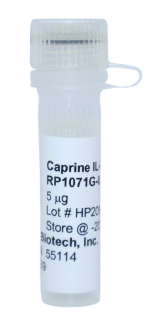
Caprine IL-6 Recombinant Protein
- Catalog Number:
- RP1071G
- Availability:
- In stock
- Application:
- Cell Culture, Control, ELISA, ELISpot Control, Western Blot Control
- 100% Homology:
- Capra hircus (goat)
 Powered by Bioz
 - Caprine IL-6 (catalog RP1071G) is a yeast-derived cytokine supplied lyophilized without carrier protein in 10% trehalose; it has no affinity tags and is naturally endotoxin-free, and should be reconstituted in sterile PBS that contains at least 0.1% carrier protein. The protein is ~20.4 kDa, 179 amino acids long (full sequence provided), and >98% pure by SDS-PAGE, with 100% amino-acid homology to goat. Store at -20°C (stable up to twelve months from date of receipt; working aliquots with carrier protein stable ~3 months) and avoid repeated freeze/thaw cycles. Product origin is the USA. It is commonly used to study IL-6 signaling and inflammatory responses (including regulation of acute-phase responses, immune-cell activation, and cytokine production); typical experimental uses include cell-culture stimulation and dosing studies, cytokine signaling assays, ELISA and neutralization assays, flow-cytometry and Western blot controls, and antibody generation/validation. Kingfisher Biotech products are supplied for research applications and are not intended for medicinal, diagnostic, or therapeutic use.
| Amino Acid Sequence | GPLGEDFKND TTPSRLLLTT PEKTEALIKH IVDKISAIRK EICEKNDECE NSKETLAENK LKLPKMEEKD GCFQSGFNQA ICLIKTTAGL LEYQIYLDFL QNEFEGNQET VMELQSSIRT LIQILKEKIA GLITTPATNT DMLEKMQSSN EWVKNAKVII ILRSLENFLQ FSLRAIRMK (179) |
| Endotoxin | Naturally endotoxin-free |
| Form | Lyophilized |
| Storage Conditions | -20°C |
| Molecular Weight | 20.4 kDa |
| Purity | >98% as visualized by SDS-PAGE analysis. |
| Expression System | Yeast |
| Form | Lyophilized |
| Country Of Origin | USA |
Caprine Interleukin-6 (IL-6) is a multifunctional pro-inflammatory cytokine and a central member of the IL-6 cytokine family—including IL-6, IL-11, IL-27, IL-31, leukemia inhibitory factor (LIF), oncostatin M (OSM), ciliary neurotrophic factor (CNTF), cardiotrophin-1 (CT-1), and cardiotrophin-like cytokine factor 1 (CLCF1)—which signal through receptor complexes utilizing the shared gp130 subunit to activate JAK/STAT and MAPK pathways. In goats (Capra hircus), IL-6 plays a key role in regulating acute-phase protein production (such as haptoglobin and serum amyloid A), leukocyte activation, B- and T-cell differentiation, and systemic inflammatory responses during infection, tissue injury, and metabolic stress. Elevated IL-6 expression is associated with economically significant caprine diseases including mastitis, caprine arthritis encephalitis (CAE), caseous lymphadenitis, pneumonia, enteric infections, and parasitic infestations, where it contributes to fever, local inflammation, and disease severity. As a biomarker, caprine IL-6 is valuable for monitoring herd health, assessing vaccine responses, and evaluating therapeutic interventions. In animal health and translational research, characterization of caprine IL-6 and related family members supports studies of host-pathogen interactions, inflammatory regulation in small ruminants, comparative immunology, and the development of immune-based strategies to improve productivity, welfare, and disease resistance in goat populations.
Citations
Please choose a size to see price
RELATED MEDIA
