Slide 1 of 1 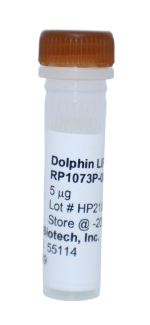
Dolphin Leukemia Inhibitory Factor (LIF) Recombinant Protein
- Catalog Number:
- RP1073P
- Availability:
- In stock
- Application:
- Cell Culture, Control, ELISA, ELISpot Control, Western Blot Control
- 100% Homology:
- Delphinapterus leucas (beluga whale), Globicephala melas (long-finned pilot whale), Lagenorhynchus obliquidens (Pacific white-sided dolphin), Monodon monoceros (narwhal), Neophocaena asiaeorientalis asiaeorientalis (Yangtze finless porpoise), Phocoena sinus (vaquita), Tursiops truncatus (common bottlenose dolphin) [Ser134Cys]
 Powered by Bioz
 - Dolphin LIF (Leukemia Inhibitory Factor) (catalog RP1073P) is a yeast-derived cytokine supplied lyophilized without carrier protein in 10% trehalose; it has no affinity tags and is naturally endotoxin-free, and should be reconstituted in sterile PBS that contains at least 0.1% carrier protein. The protein is ~19.7 kDa, 180 amino acids long (full sequence provided), and >98% pure by SDS-PAGE, with 100% amino-acid homology to common bottlenose dolphin, beluga whale, Yangtze finless porpoise, Pacific white-sided dolphin, narwhal, long-finned pilot whale, and vaquita. Store at -20°C (stable up to twelve months from date of receipt; working aliquots with carrier protein stable ~3 months) and avoid repeated freeze/thaw cycles. Product origin is the USA. It is commonly used to study LIF signaling and cellular differentiation and survival (including maintenance of stem cell pluripotency and regulation of cell growth and inflammation); typical experimental uses include cell-culture stimulation and dosing studies, signaling and differentiation assays, ELISA and neutralization assays, flow-cytometry and Western blot controls, and antibody generation/validation. Kingfisher Biotech products are supplied for research applications and are not intended for medicinal, diagnostic, or therapeutic use.
| Amino Acid Sequence | SPLPITPVNA TCATRHPCHS NLMNQIKNQL AQLNSSAKAL FILYYTAQGE PFPNNLDKLC SPNVTDFPPF HANGTERARL VELYRIIAYL GASLGNITRD QKVLNPSAHS LHSKLNATAD VMRGLLSNVL CRLCSKYHVA HVDVAYGPDT SGKDVFQKKK LGCQLLGKYK QVIAVVAQAF (180) |
| Endotoxin | Naturally endotoxin-free |
| Form | Lyophilized |
| Storage Conditions | -20°C |
| Molecular Weight | 19.7 kDa |
| Purity | >98% as visualized by SDS-PAGE analysis. |
| Expression System | Yeast |
| Form | Lyophilized |
| Country Of Origin | USA |
Dolphin Leukemia Inhibitory Factor (LIF) is a multifunctional cytokine belonging to the IL-6 family—which includes IL-6, IL-11, oncostatin M (OSM), ciliary neurotrophic factor (CNTF), cardiotrophin-1 (CT-1), cardiotrophin-like cytokine factor 1 (CLCF1), and IL-27—all of which signal through receptor complexes containing the shared gp130 subunit. In dolphins, particularly the bottlenose dolphin (Tursiops truncatus), LIF binds to the LIF receptor (LIFR) in association with gp130, activating JAK/STAT3, MAPK, and PI3K signaling pathways that regulate cell survival, differentiation, immune modulation, and tissue repair. Dolphin LIF is likely involved in reproductive processes such as embryo implantation and placental development, as well as in hematopoiesis and neural tissue maintenance. In dolphin health, LIF-mediated STAT3 signaling may contribute to regulation of inflammatory responses during respiratory infections, wound healing, and systemic inflammatory conditions, and could influence tissue remodeling in response to environmental stressors such as pollutant exposure or harmful algal blooms. Dysregulated LIF expression may be associated with fibrosis or tumor progression. As dolphins serve as sentinel species for marine ecosystem health, characterization of LIF supports research into immune regulation, reproductive biology, regenerative processes, and comparative IL-6 family signaling. Study of dolphin LIF enhances understanding of cytokine-driven tissue resilience and inflammatory balance in marine mammals and broader mammalian systems.
Citations
Please choose a size to see price
RELATED MEDIA
