Slide 1 of 1 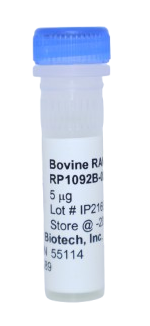
Multi-species (Bovine, Ovine, Caprine) RANKL (TNFSF11) Recombinant Protein
- Catalog Number:
- RP1092B
- Availability:
- In stock
- Application:
- Cell Culture, Control, ELISA, ELISpot Control, Western Blot Control
- 100% Homology:
- Bison bison bison (American buffalo), Bos indicus (zebu), Bos mutus (wild yak), Bos taurus (cattle), Bubalus bubalis (water buffalo), Capra hircus (goat), Ovis aries (sheep)
 Powered by Bioz
 - Bovine/Ovine/Caprine RANKL (Receptor Activator of NF-κB Ligand, TNFSF11) (catalog RP1092B) is a yeast-derived cytokine supplied lyophilized without carrier protein in 10% trehalose; it has no affinity tags and is naturally endotoxin-free, and should be reconstituted in sterile PBS that contains at least 0.1% carrier protein. The protein is ~19.6 kDa, 175 amino acids long (full sequence provided), and >98% pure by SDS-PAGE, with 100% amino-acid homology across cattle, sheep, goat, American buffalo, zebu, wild yak, and water buffalo. Store at -20°C (stable up to twelve months from date of receipt; working aliquots with carrier protein stable ~3 months) and avoid repeated freeze/thaw cycles. Product origin is the USA. It is commonly used to study RANKL signaling and bone metabolism (including regulation of osteoclast differentiation and activation); typical experimental uses include cell-culture stimulation and differentiation assays, signaling studies, ELISA and neutralization assays, flow-cytometry and Western blot controls, and antibody generation/validation. Kingfisher Biotech products are supplied for research applications and are not intended for medicinal, diagnostic, or therapeutic use.
| Amino Acid Sequence | EKAMVEGSWL DLARRNKPEI QPFAHLTINA TDIPSGSHKV TLSCWYHDRG WAKISNMTFS NGKLIVNQDG FYYLYANICF RHHETSGNLS ANYLQLMVYV TKTSIKIPSS HTLMKGGSTK YWLGNSEFHF YSINVGGFFK LRSGEKISIE VSNPSLLDPD QDATYFGAFK VRDID (175) |
| Endotoxin | Naturally endotoxin-free |
| Form | Lyophilized |
| Storage Conditions | -20°C |
| Molecular Weight | 19.6 kDa |
| Purity | >98% as visualized by SDS-PAGE analysis. |
| Expression System | Yeast |
| Form | Lyophilized |
| Country Of Origin | USA |
Bovine, Ovine, and Caprine RANKL (Receptor Activator of Nuclear Factor κB Ligand, also known as TNFSF11, TRANCE, or OPGL) is a cytokine belonging to the tumor necrosis factor (TNF) superfamily, which includes related ligands such as TNF-α, Fas ligand (FasL), CD40 ligand (CD40L), and TRAIL that regulate immune signaling, cell survival, and apoptosis. In cattle (Bos taurus), sheep (Ovis aries), and goats (Capra hircus), the RANKL protein is identical at the amino acid level, reflecting strong evolutionary conservation and indicating similar biological functions across these ruminant species. RANKL is expressed primarily by osteoblasts, stromal cells, activated T lymphocytes, and other immune cells, and it binds to its receptor RANK (receptor activator of NF-κB) on osteoclast precursors and mature osteoclasts. This interaction activates intracellular signaling pathways including NF-κB, MAPK, and NFATc1, promoting osteoclast differentiation, activation, and bone resorption. RANKL activity is tightly regulated by osteoprotegerin (OPG, TNFRSF11B), a soluble decoy receptor that binds RANKL and prevents interaction with RANK, thereby controlling bone remodeling. In ruminants, RANKL signaling is important for skeletal development, bone turnover, and calcium homeostasis, particularly during physiological states such as growth, pregnancy, and lactation, when mineral metabolism is highly regulated. Because bone metabolism and mineral balance are critical for livestock growth, reproductive health, and dairy production, bovine, ovine, and caprine RANKL is studied in research on bone biology, osteoclast regulation, and metabolic disorders affecting skeletal health in ruminant species.
Citations
Please choose a size to see price
RELATED MEDIA
