Slide 1 of 1 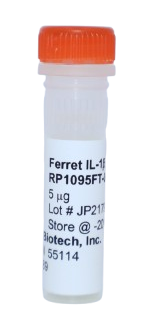
Ferret IL-1 beta Recombinant Protein
- Catalog Number:
- RP1095FT
- Availability:
- In stock
- Application:
- Cell Culture, Control, ELISA, ELISpot Control, Western Blot Control
- 100% Homology:
- Mustela lutreola (European mink), Mustela nigripes (black-footed ferret), Mustela putorius furo (domestic ferret)
 Powered by Bioz
 - Ferret IL-1β (catalog RP1095FT) is a yeast-derived cytokine supplied lyophilized without carrier protein in 10% trehalose; it has no affinity tags and is naturally endotoxin-free, and should be reconstituted in sterile PBS that contains at least 0.1% carrier protein. The protein is ~17.6 kDa, 152 amino acids long (full sequence provided), and >98% pure by SDS-PAGE, with 100% amino-acid homology to domestic ferret, European mink, and black-footed ferret. Store at -20°C (stable up to twelve months from date of receipt; working aliquots with carrier protein stable ~3 months) and avoid repeated freeze/thaw cycles. Product origin is the USA. It is commonly used to study IL-1β signaling and inflammatory responses (including regulation of immune-cell activation, cytokine production, and fever responses); typical experimental uses include cell-culture stimulation and dosing studies, cytokine signaling assays, ELISA and neutralization assays, flow-cytometry and Western blot controls, and antibody generation/validation. Kingfisher Biotech products are supplied for research applications and are not intended for medicinal, diagnostic, or therapeutic use.
| Amino Acid Sequence | APPRSLDCKF QDINQKSLVL YNSYELRALH LNGTSVNQQA VFRMTFVQED EDITKIPVAL CIKEKNLYLS CVMKDGKPTL QLEMLDPKVY PKKRMEKRFV FNKTEIKKKV EFESSQFPNW YISTSQAEAM PVFLGNNRGG HDITDFTMEL SS (152) |
| Endotoxin | Naturally endotoxin-free |
| Form | Lyophilized |
| Storage Conditions | -20°C |
| Molecular Weight | 17.6 kDa |
| Purity | >98% as visualized by SDS-PAGE analysis. |
| Expression System | Yeast |
| Form | Lyophilized |
| Country Of Origin | USA |
Ferret Interleukin-1 Beta (IL-1β) is a potent pro-inflammatory cytokine produced primarily by activated macrophages, monocytes, and dendritic cells in ferrets (Mustela putorius furo) following recognition of pathogens or tissue injury. Synthesized as an inactive precursor (pro–IL-1β), it is cleaved into its active form by caspase-1 within the inflammasome complex and subsequently signals through the IL-1 receptor (IL-1R1), activating NF-κB and MAPK pathways that promote fever, leukocyte recruitment, vascular permeability, and amplification of inflammatory responses. In ferret health and research, IL-1β is prominently induced during respiratory viral infections such as influenza virus and SARS-CoV-2, where its expression contributes to lung inflammation, immune cell infiltration, and, in severe cases, immunopathology. Elevated IL-1β levels correlate with disease severity in these models, reflecting its role in cytokine-driven pulmonary pathology. Because ferrets are widely used as translational models for human respiratory viral infections and transmission studies, characterization of IL-1β is essential for understanding inflammasome activation, cytokine storm mechanisms, vaccine responses, and evaluation of anti-inflammatory or antiviral therapeutics. As both a biomarker and mediator of innate immune activation, ferret IL-1β plays a central role in respiratory disease research and comparative studies of inflammatory regulation.
Citations
Please choose a size to see price
RELATED MEDIA
