Slide 1 of 1 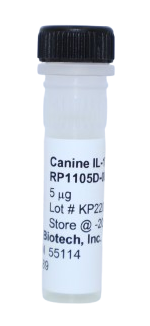
Canine IL-17F Recombinant Protein
- Catalog Number:
- RP1105D
- Availability:
- In stock
- Application:
- Cell Culture, Control, ELISA, ELISpot Control, Western Blot Control
- 100% Homology:
- Canis lupus dingo (dingo), Canis lupus familiaris (dog), Vulpes lagopus (Arctic fox), Vulpes vulpes (red fox)
 Powered by Bioz
 - Canine IL-17F (Interleukin-17F) (catalog RP1105D) is a yeast-derived cytokine supplied lyophilized without carrier protein in 10% trehalose; it has no affinity tags and is naturally endotoxin-free, and should be reconstituted in sterile PBS that contains at least 0.1% carrier protein. The protein is ~14.7 kDa, 130 amino acids long (full sequence provided), and >98% pure by SDS-PAGE, with 100% amino-acid homology to dog, dingo, Arctic fox, and red fox. Store at -20°C (stable up to twelve months from date of receipt; working aliquots with carrier protein stable ~3 months) and avoid repeated freeze/thaw cycles. Product origin is the USA. It is commonly used to study IL-17F signaling and inflammatory responses (including regulation of cytokine production and neutrophil recruitment); typical experimental uses include cell-culture stimulation and dosing studies, cytokine signaling assays, ELISA and neutralization assays, flow-cytometry and Western blot controls, and antibody generation/validation. Kingfisher Biotech products are supplied for research applications and are not intended for medicinal, diagnostic, or therapeutic use.
| Amino Acid Sequence | ARKHLKAGET ALCPPLEDNS VRVDIRILRQ NRGISISNDF QNRSSSPWDY NITRDPHRFP SEIAEAQCRH SGCINAEGQE DSSMNSVPIQ QEFLVLRREP QGCSRSFRLE KVLVTVGCTC VTPIVRYVRA (130) |
| Endotoxin | Naturally endotoxin-free |
| Form | Lyophilized |
| Storage Conditions | -20°C |
| Molecular Weight | 14.7 kDa |
| Purity | >98% as visualized by SDS-PAGE analysis. |
| Expression System | Yeast |
| Form | Lyophilized |
| Country Of Origin | USA |
Canine IL-17F (Interleukin-17F) is a pro-inflammatory cytokine belonging to the IL-17 family that contributes to host defense and inflammatory regulation in dogs (Canis lupus familiaris). IL-17F is produced primarily by Th17 CD4⁺ T cells, as well as by γδ T cells and other innate lymphoid populations, in response to microbial infection and immune stimulation. It signals through the IL-17 receptor complex (IL-17RA/IL-17RC) to induce expression of pro-inflammatory cytokines, chemokines such as CXCL8, and antimicrobial peptides, thereby promoting neutrophil recruitment and strengthening mucosal and barrier immunity in the respiratory, gastrointestinal, and cutaneous tissues. In healthy dogs, basal IL-17F expression is generally low but increases during bacterial and fungal infections, allergic inflammation, and chronic immune-mediated conditions. IL-17F often acts in concert with IL-17A to amplify Th17-driven inflammatory responses. In veterinary and comparative medicine research, canine IL-17F is of interest in studies of atopic dermatitis, inflammatory bowel disease, immune-mediated polyarthritis, and chronic airway disease, where Th17-associated pathways contribute to neutrophilic inflammation and tissue pathology. Characterization of canine IL-17F provides valuable insight into inflammatory signaling mechanisms and potential therapeutic targets in canine immune-mediated disease.
Citations
Please choose a size to see price
RELATED MEDIA
