Slide 1 of 1 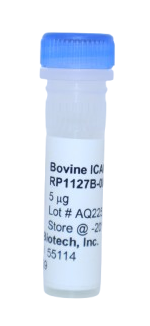
Bovine ICAM-1 Recombinant Protein
- Catalog Number:
- RP1127B
- Availability:
- In stock
- Application:
- Cell Culture, Control, ELISA, ELISpot Control, Western Blot Control
- 100% Homology:
- Bos indicus (zebu), Bos taurus (cattle)
 Powered by Bioz
- Bovine ICAM-1 (Intercellular Adhesion Molecule 1, CD54) (catalog RP1127B) is a yeast-derived adhesion molecule supplied lyophilized without carrier protein in 10% trehalose; it has no affinity tags and is naturally endotoxin-free, and should be reconstituted in sterile PBS that contains at least 0.1% carrier protein. The protein is ~50.0 kDa, 453 amino acids long (full sequence provided), and >98% pure by SDS-PAGE, with 100% amino-acid homology to cattle and zebu. Store at -20°C (stable up to twelve months from date of receipt; working aliquots with carrier protein stable ~3 months) and avoid repeated freeze/thaw cycles. Product origin is the USA. It is commonly used to study ICAM-1-mediated cell adhesion and immune responses (including leukocyte adhesion, transmigration, and inflammatory signaling); typical experimental uses include cell-culture stimulation and adhesion assays, signaling studies, ELISA and neutralization assays, flow-cytometry and Western blot controls, and antibody generation/validation. Kingfisher Biotech products are supplied for research applications and are not intended for medicinal, diagnostic, or therapeutic use.
| Amino Acid Sequence | GISIHPSKAI IPRGDSLTVN CSNSCDQKST FGLETVLIKE EVGRGDNWKV FQLRDVQEDI ELFCYSNCHK EQTIASMNLT VYWFPEHVEL APLPLWQPVG EELNLSCLVS GGAPRAHLSV VLLRGEEELG RQPVGKGEPA KVMFTVQSRR EDHGTNFSCR WELDLRSQGL ELFQNTSAPR KLQTYVLPSI DPHLEVPPIV EVGSRWPVNC TLDGLFPASD AKVYLVLGDQ KLESNITYDG DSVLAKAWME ENEEGTHSLK CSVTLGEVSR RTQENVTVYS FPLPTLTLSP PEVSEWTTVT VECVTRDGAV VKLNGTSAVP PGPRAQLKLN ASASDHRSNF SCSAALEIAG QVVHKHQTLE LHVLYGPRLD QRDCPGNWTW QEGSEQTLKC EAQGNPIPKL NCSRKGDGAS LPIGDLRPVR REVAGTYLCR ATSARGRVTR EVVLNVLHGQ NIL (453) |
| Endotoxin | Naturally endotoxin-free |
| Use | For Research Use Only. Not For Diagnostic Or Therapeutic Use. |
| Form | Lyophilized |
| Storage Conditions | -20°C |
| Molecular Weight | 50.0 kDa |
| Purity | >98% as visualized by SDS-PAGE analysis. |
| Expression System | Yeast |
| Form | Lyophilized |
| Country Of Origin | USA |
Bovine Intercellular Adhesion Molecule-1 (ICAM-1, CD54) is a transmembrane glycoprotein member of the immunoglobulin superfamily that plays a critical role in leukocyte adhesion, trafficking, and inflammatory signaling in cattle (Bos taurus). Expressed on endothelial cells, epithelial cells, macrophages, and other immune and tissue-resident cells, bovine ICAM-1 is upregulated in response to pro-inflammatory cytokines such as TNF-α, IL-1β, and IFN-γ. It binds to β2 integrins, including LFA-1 (CD11a/CD18) and Mac-1 (CD11b/CD18), on leukocytes to mediate firm adhesion and transmigration of neutrophils and lymphocytes across the endothelium into inflamed tissues. Elevated ICAM-1 expression has been associated with economically significant bovine diseases such as mastitis, bovine respiratory disease (BRD), endometritis, and enteric infections, where enhanced leukocyte infiltration contributes to both pathogen clearance and tissue pathology. In the mammary gland, ICAM-1 facilitates neutrophil migration during intramammary infection and serves as a marker of inflammatory activation. In animal health and research applications, characterization of bovine ICAM-1 supports studies of host-pathogen interactions, vascular inflammation, immune cell recruitment, and evaluation of therapeutic or vaccine strategies aimed at modulating inflammatory responses to improve cattle health, productivity, and welfare.
Citations
Please choose a size to see price
RELATED MEDIA
