Slide 1 of 1 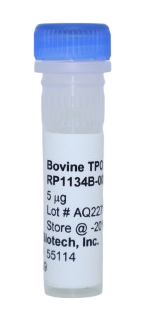
Bovine Thrombopoietin Recombinant Protein
- Catalog Number:
- RP1134B
- Availability:
- In stock
- Application:
- Cell Culture, Control, ELISA, ELISpot Control, Western Blot Control
- 100% Homology:
- Bos taurus (cattle)
 Powered by Bioz
 - Bovine Thrombopoietin (TPO) (catalog RP1134B) is a yeast-derived cytokine supplied lyophilized without carrier protein in 10% trehalose; it has no affinity tags and is naturally endotoxin-free, and should be reconstituted in sterile PBS that contains at least 0.1% carrier protein. The protein is ~34.9 kDa, 332 amino acids long (full sequence provided), and >98% pure by SDS-PAGE, with 100% amino-acid homology to cattle. Store at -20°C (stable up to twelve months from date of receipt; working aliquots with carrier protein stable ~3 months) and avoid repeated freeze/thaw cycles. Product origin is the USA. It is commonly used to study thrombopoietin signaling and hematopoiesis (including regulation of megakaryocyte development and platelet production); typical experimental uses include cell-culture stimulation and differentiation assays, signaling studies, ELISA and neutralization assays, flow-cytometry and Western blot controls, and antibody generation/validation. Kingfisher Biotech products are supplied for research applications and are not intended for medicinal, diagnostic, or therapeutic use.
| Amino Acid Sequence | SPAPPACDPR LLNKLLRDSH VLHSRLSQCP DVNPLSTPVL LPVVDFSLGE WKTQTEQTKA QDVLGTTTLL LEAVMTARGQ LGPTCLSSLL VQLSGQVRLL LGALQGLLGT QLPPQGRTTA HKDPSAIFLS FQQLLRGKVR FLLLVVGPSL CAKRAPPATA VPGSISPLLT LNKLPNRTSG LLETNSSVSA RTTGFGLPNR LQGFRAKIPG LLNQTSRSLG QIPGHLNGTQ GPLSGVHGLF PGPSPRALGA PDIPLGTSDM GSLPPYLQPG DSPSPAHPPP GQYTLFSPSP TSPIPTVHLQ PLLPDPSAIT PNSSSSLLVA AHSHFRNLSQ EE (332) |
| Endotoxin | Naturally endotoxin-free |
| Form | Lyophilized |
| Storage Conditions | -20°C |
| Molecular Weight | 34.9 kDa |
| Purity | >98% as visualized by SDS-PAGE analysis. |
| Expression System | Yeast |
| Form | Lyophilized |
| Country Of Origin | USA |
Bovine Thrombopoietin (TPO) (also known as THPO or megakaryocyte growth and development factor, MGDF) is a hematopoietic cytokine that plays a central role in the regulation of platelet production and megakaryocyte development in cattle (Bos taurus). TPO belongs to the class I cytokine family, which also includes erythropoietin (EPO), granulocyte colony-stimulating factor (G-CSF), and prolactin, cytokines that regulate blood cell development through related receptor-mediated signaling mechanisms. Bovine TPO is primarily produced by the liver, with additional expression in the kidney, bone marrow stromal cells, and other tissues, and exerts its effects by binding to the c-Mpl receptor (MPL, CD110) on hematopoietic stem cells and megakaryocyte progenitor cells. Activation of the TPO receptor stimulates intracellular signaling pathways including JAK2/STAT, MAPK, and PI3K/AKT, which promote megakaryocyte proliferation, maturation, and platelet formation, while also supporting hematopoietic stem cell survival and self-renewal. In cattle, thrombopoietin plays an important role in maintaining normal platelet counts and hemostasis, and it contributes to recovery of platelet production following bone marrow stress, inflammation, or blood loss. Because TPO regulates platelet generation and stem cell maintenance, bovine thrombopoietin is studied in research on hematopoiesis, platelet biology, and bone marrow function, with relevance to understanding blood cell development and immune responses in livestock.
Citations
Please choose a size to see price
RELATED MEDIA
