Slide 1 of 1 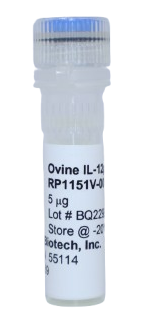
Multi-species (Ovine, Caprine) IL-12/IL-23 p40 Recombinant Protein
- Catalog Number:
- RP1151V
- Availability:
- In stock
- Application:
- Cell Culture, Control, ELISA, ELISpot Control, Western Blot Control
- 100% Homology:
- Capra hircus (goat), Ovis aries (sheep)
 Powered by Bioz
 - Ovine/Caprine IL-12 p40 (Interleukin-12 subunit p40) (catalog RP1151V) is a yeast-derived cytokine supplied lyophilized without carrier protein in 10% trehalose; it has no affinity tags and is naturally endotoxin-free, and should be reconstituted in sterile PBS that contains at least 0.1% carrier protein. The protein is ~34.5 kDa, 305 amino acids long (full sequence provided), and >98% pure by SDS-PAGE, with 100% amino-acid homology across sheep and goat. Store at -20°C (stable up to twelve months from date of receipt; working aliquots with carrier protein stable ~3 months) and avoid repeated freeze/thaw cycles. Product origin is the USA. It is commonly used to study IL-12 signaling and immune responses (including regulation of Th1 differentiation and cytokine production); typical experimental uses include cell-culture stimulation and dosing studies, cytokine signaling assays, ELISA and neutralization assays, flow-cytometry and Western blot controls, and antibody generation/validation. Kingfisher Biotech products are supplied for research applications and are not intended for medicinal, diagnostic, or therapeutic use.
| Amino Acid Sequence | IWELEKNVYV VELDWYPNAP GETVVLTCDT PEEDGITWTS DQSSEVLGSG KTLTIQVKEF GDAGQYTCHK GGEVLSRSLL LLHKKEDGIW STDILKDQKE PKAKSFLKCE AKDYSGHFTC SWLTAISTNL KFSVKSSRGS SDPRGVTCGA ASLSAEKVSM DHREYNKYTV ECQEGSACPA AEESLPIEVV MEAVHKLKYE NYTSSFFIRD IIKPDPPKNL QLRPLKNSRQ VEVSWEYPDT WSTPHSYFSL TFCVQVQGKN KREKKLFTDQ TSAKVTCHKD ANIRVQARDR YYSSFWSEWA SVSCS (305) |
| Endotoxin | Naturally endotoxin-free |
| Form | Lyophilized |
| Storage Conditions | -20°C |
| Molecular Weight | 34.5 kDa |
| Purity | >98% as visualized by SDS-PAGE analysis. |
| Expression System | Yeast |
| Form | Lyophilized |
| Country Of Origin | USA |
Ovine/Caprine Interleukin-12/Interleukin-23 p40 (IL-12/IL-23 p40) is a cytokine subunit that plays an important role in regulating immune responses in sheep (Ovis aries) and goats (Capra hircus). The IL-12/IL-23 p40 protein is identical at the amino acid level in these two species, reflecting strong conservation of this immune signaling molecule in small ruminants. The p40 subunit is shared by two heterodimeric cytokines, IL-12 and IL-23, where it pairs with the p35 subunit to form IL-12 and with the p19 subunit to form IL-23. These cytokines are produced primarily by activated antigen-presenting cells, including macrophages and dendritic cells, in response to microbial infection or inflammatory stimuli. Ovine and caprine IL-12/IL-23 p40 contributes to activation of natural killer (NK) cells and differentiation of T helper cells toward Th1-type immune responses, promoting production of interferon-γ (IFN-γ) and enhancing cell-mediated immunity against intracellular pathogens. Through IL-23 signaling, the p40 subunit also supports maintenance and expansion of Th17 cells involved in inflammatory responses and host defense. In sheep and goats, IL-12/IL-23 p40 participates in immune responses against bacterial, viral, and parasitic infections, including important livestock pathogens such as Mycobacterium avium subsp. paratuberculosis, Brucella spp., and gastrointestinal nematodes. Due to its role in regulating cellular immunity, ovine/caprine IL-12/IL-23 p40 is widely studied in veterinary immunology and translational research, including investigations of host–pathogen interactions, vaccine development, and immune responses relevant to small ruminant health and comparative biomedical research.
Citations
Please choose a size to see price
RELATED MEDIA
