Slide 1 of 1 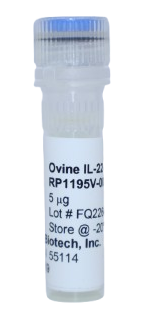
Ovine IL-22 Recombinant Protein
- Catalog Number:
- RP1195V
- Availability:
- In stock
- Application:
- Cell Culture, Control, ELISA, ELISpot Control, Western Blot Control
- 100% Homology:
- Ovis aries (sheep)
 Powered by Bioz
 - Ovine IL-22 (Interleukin-22) (catalog RP1195V) is a yeast-derived cytokine supplied lyophilized without carrier protein in 10% trehalose; it has no affinity tags and is naturally endotoxin-free, and should be reconstituted in sterile PBS that contains at least 0.1% carrier protein. The protein is ~18.3 kDa, 157 amino acids long (full sequence provided), and >98% pure by SDS-PAGE, with 100% amino-acid homology to sheep. Store at -20°C (stable up to twelve months from date of receipt; working aliquots with carrier protein stable ~3 months) and avoid repeated freeze/thaw cycles. Product origin is the USA. It is commonly used to study IL-22 signaling and immune responses (including regulation of epithelial cell function, tissue repair, and inflammation); typical experimental uses include cell-culture stimulation and dosing studies, cytokine signaling assays, ELISA and neutralization assays, flow-cytometry and Western blot controls, and antibody generation/validation. Kingfisher Biotech products are supplied for research applications and are not intended for medicinal, diagnostic, or therapeutic use.
| Amino Acid Sequence | APITSHCRLN KSDFQEPYIF NHTFTLAQEA SLADNITDVR LIGNKLFQGI NQVTKRCYVL KQVLNFILEE VLFPRSDEFH PHMKKVVPFF SKLSKKLSQC HIENDNQHIQ RNVQNLKNTV KKLGESGEIK VIGELNLLFI TLKRECAQVE QGWKMDY (157) |
| Endotoxin | Naturally endotoxin-free |
| Form | Lyophilized |
| Storage Conditions | -20°C |
| Molecular Weight | 18.3 kDa |
| Purity | >98% as visualized by SDS-PAGE analysis. |
| Expression System | Yeast |
| Form | Lyophilized |
| Country Of Origin | USA |
Ovine IL-22 (Interleukin-22) is a member of the IL-10 cytokine family that plays a critical role in mucosal immunity and epithelial barrier protection in sheep (Ovis aries). IL-22 is produced primarily by activated CD4⁺ T cells, including Th17- and Th22-like subsets, as well as by γδ T cells—which are prominent in ruminants—and innate lymphoid cells (ILC3s) in response to microbial infection and inflammatory stimulation. It signals through the IL-22 receptor complex (IL-22R1 and IL-10R2), expressed mainly on epithelial and stromal cells, activating downstream JAK/STAT pathways—particularly STAT3—to induce antimicrobial peptide production, enhance chemokine expression, promote epithelial cell proliferation, and support tissue repair. In healthy sheep, basal IL-22 expression is generally low but increases during bacterial, viral, and parasitic infections, especially at mucosal surfaces of the gastrointestinal, respiratory, and mammary tissues. Ovine IL-22 has been implicated in immune responses to gastrointestinal nematodes (e.g., Haemonchus contortus), Mycobacterium avium subspecies paratuberculosis, respiratory pathogens, and mastitis-causing bacteria. In veterinary and agricultural research, ovine IL-22 serves as a biomarker of mucosal immune activation and epithelial defense and is studied in the context of host–pathogen interactions, vaccine responses, and maintenance of barrier integrity in small ruminant health and production systems.
Citations
Please choose a size to see price
RELATED MEDIA
