Slide 1 of 1 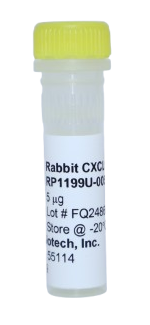
Multi-species (Rabbit, Ferret) CXCL12 (SDF-1) Recombinant Protein
- Catalog Number:
- RP1199U
- Availability:
- In stock
- Application:
- Cell Culture, Control, ELISA, ELISpot Control, Western Blot Control
- 100% Homology:
- Dipodomys ordii (Ord's kangaroo rat), Dipodomys spectabilis (banner-tailed kangaroo rat), Heterocephalus glaber (naked mole-rat), Mustela erminea (ermine), Mustela putorius furo (domestic ferret), Ochotona princeps (American pika), Octodon degus (degu), Oryctolagus cuniculus (rabbit), Perognathus longimembris pacificus (Pacific pocket mouse), Sciurus carolinensis (gray squirrel)
 Powered by Bioz
 - Rabbit CXCL12 (SDF-1, Stromal Cell-Derived Factor 1) (catalog RP1199U) is a yeast-derived chemokine supplied lyophilized without carrier protein in 10% trehalose; it has no affinity tags and is naturally endotoxin-free, and should be reconstituted in sterile PBS that contains at least 0.1% carrier protein. The protein is ~8.6 kDa, 73 amino acids long (full sequence provided), and >98% pure by SDS-PAGE, with 100% amino-acid homology to rabbit, domestic ferret, American pika, gray squirrel, naked mole-rat, degu, ermine, Pacific pocket mouse, Ord's kangaroo rat, and banner-tailed kangaroo rat. Store at -20°C (stable up to twelve months from date of receipt; working aliquots with carrier protein stable ~3 months) and avoid repeated freeze/thaw cycles. Product origin is the USA. It is commonly used to study CXCL12/SDF-1 signaling and cell migration (including regulation of stem cell homing, lymphocyte trafficking, and tissue repair); typical experimental uses include cell-culture stimulation and migration assays, chemotaxis and signaling studies, ELISA and neutralization assays, flow-cytometry and Western blot controls, and antibody generation/validation. Kingfisher Biotech products are supplied for research applications and are not intended for medicinal, diagnostic, or therapeutic use.
| Amino Acid Sequence | GKPVSLSYRC PCRFFESHVA RANVKHLKIL NTPNCALQIV ARLKSNNRQV CIDPKLKWIQ EYLEKALNKR FKM (73) |
| Endotoxin | Naturally endotoxin-free |
| Form | Lyophilized |
| Storage Conditions | -20°C |
| Molecular Weight | 8.6 kDa |
| Purity | >98% as visualized by SDS-PAGE analysis. |
| Expression System | Yeast |
| Form | Lyophilized |
| Country Of Origin | USA |
Rabbit (Oryctolagus cuniculus) and Ferret (Mustela putorius furo) CXCL12 (C-X-C motif chemokine ligand 12), also known as SDF-1 (stromal cell–derived factor-1), is a homeostatic chemokine belonging to the CXC chemokine family that plays a critical role in cell migration, immune cell trafficking, and tissue development. In rabbits and ferrets, the CXCL12 protein is identical at the amino acid level, indicating strong evolutionary conservation and suggesting similar biological functions in these species. CXCL12 is produced by stromal cells, endothelial cells, epithelial cells, fibroblasts, and bone marrow niche cells, where it regulates the migration and positioning of hematopoietic stem cells, lymphocytes, and other progenitor cells. The chemokine primarily signals through the receptors CXCR4 and ACKR3 (CXCR7), guiding immune cells and stem cells to specific tissues and supporting hematopoiesis, immune surveillance, tissue repair, and organ development. In rabbits and ferrets, the CXCL12–CXCR4 signaling axis is important for maintaining bone marrow stem cell niches and lymphoid tissue organization, and it has been studied in animal models of cardiovascular disease and respiratory viral infections, including ferret models of influenza virus infection, where chemokine-mediated immune cell trafficking contributes to immune responses and tissue repair during lung inflammation. These models help researchers investigate stem cell migration, immune regulation, and chemokine signaling pathways relevant to both veterinary and human biomedical research.
Citations
Please choose a size to see price
RELATED MEDIA
