Slide 1 of 1 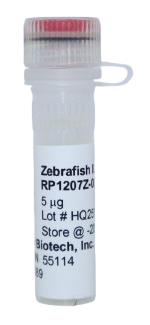
Zebrafish IL-6 Recombinant Protein
- Catalog Number:
- RP1207Z
- Availability:
- In stock
- Application:
- Cell Culture, Control, ELISA, ELISpot Control, Western Blot Control
- 100% Homology:
- Danio rerio (zebrafish)
 Powered by Bioz
 - Zebrafish IL-6 (Interleukin-6) (catalog RP1207Z) is a yeast-derived cytokine supplied lyophilized without carrier protein in 10% trehalose; it has no affinity tags and is naturally endotoxin-free, and should be reconstituted in sterile PBS that contains at least 0.1% carrier protein. The protein is ~24.1 kDa, 208 amino acids long (full sequence provided), and >98% pure by SDS-PAGE, with 100% amino-acid homology to zebrafish. Store at -20°C (stable up to twelve months from date of receipt; working aliquots with carrier protein stable ~3 months) and avoid repeated freeze/thaw cycles. Product origin is the USA. It is commonly used to study IL-6 signaling and immune responses (including regulation of inflammation, acute-phase responses, and cytokine production); typical experimental uses include cell-culture stimulation and dosing studies, cytokine signaling assays, ELISA and neutralization assays, flow-cytometry and Western blot controls, and antibody generation/validation. Kingfisher Biotech products are supplied for research applications and are not intended for medicinal, diagnostic, or therapeutic use.
| Amino Acid Sequence | DPVPVFSSMG ELSEISGDEV QDVDVKSLLG DRQKWHLMAR DLYKDVKTLR DEQFERDFRE MVNMTAFEGV RISTPLLKPS DRCLSKNFST ERCLTRIYSV LTWYKDNWNY IEKENLTSVL VNDIKHSTKR LLEAINSQLQ VRDGEMDQTS STSLSFKSAW TRKTTVHSIL FNFSSVMIDA CRAINYMSRR KRGKDPKRTG DWGSADKN (208) |
| Endotoxin | Naturally endotoxin-free |
| Form | Lyophilized |
| Storage Conditions | -20°C |
| Molecular Weight | 24.1 kDa |
| Purity | >98% as visualized by SDS-PAGE analysis. |
| Expression System | Yeast |
| Form | Lyophilized |
| Country Of Origin | USA |
Zebrafish (Danio rerio) Interleukin-6 (IL-6) is a conserved pro-inflammatory cytokine that plays a central role in regulating innate immune responses and inflammation in teleost fish. Although structurally distinct from mammalian IL-6, zebrafish IL-6 functions through gp130-associated receptor complexes to activate JAK/STAT3 signaling pathways, promoting expression of acute-phase genes, leukocyte recruitment, and inflammatory mediators. IL-6 is rapidly induced in response to bacterial infections (e.g., Mycobacterium marinum, Streptococcus spp.), viral challenges, tissue injury, and environmental stress, where it contributes to macrophage and neutrophil activation and coordination of systemic immune responses. Due to the optical transparency of zebrafish larvae and the availability of transgenic and gene-editing tools, zebrafish IL-6 has been extensively studied in models of infection, wound healing, cancer, metabolic disease, and neuroinflammation. Dysregulated IL-6/STAT3 signaling has been linked to chronic inflammation and tumor progression in zebrafish cancer models. As a key biomarker and functional mediator of inflammation, zebrafish IL-6 supports high-throughput drug screening, genetic studies of immune regulation, and comparative immunology research, reinforcing the zebrafish as a powerful vertebrate model for investigating cytokine biology and inflammatory disease mechanisms.
Citations
Please choose a size to see price
RELATED MEDIA
