Slide 1 of 1 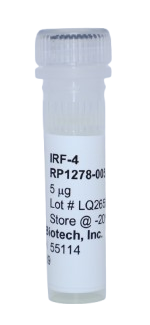
IRF-4 Recombinant Protein
- Catalog Number:
- RP1278
- Availability:
- In stock
- Application:
- Cell Culture, Control, ELISA, ELISpot Control, Western Blot Control
- 100% Homology:
- Acinonyx jubatus (cheetah), Ailuropoda melanoleuca (giant panda), Aotus nancymaae (Ma's night monkey), Bos indicus (zebu), Bos mutus (wild yak), Bos taurus (cattle), Camelus bactrianus (Bactrian camel), Camelus dromedarius (Arabian camel), Capra hircus (goat), Cavia porcellus (domestic guinea pig), Ceratotherium simum simum (southern white rhinoceros), Cercocebus atys (sooty mangabey), Chinchilla lanigera (long-tailed chinchilla), Chlorocebus sabaeus (green monkey), Dipodomys ordii (Ord's kangaroo rat), Echinops telfairi (small Madagascar hedgehog), Eptesicus fuscus (big brown bat), Equus asinus (ass), Equus caballus (horse), Erinaceus europaeus (western European hedgehog), Felis catus (domestic cat), Galeopterus variegatus (Sunda flying lemur), Gorilla gorilla gorilla (western lowland gorilla), Heterocephalus glaber (naked mole-rat), Homo sapiens (human), Ictidomys tridecemlineatus (thirteen-lined ground squirrel), Jaculus jaculus (lesser Egyptian jerboa), Leptonychotes weddellii (Weddell seal), Loxodonta africana (African savanna elephant), Macaca fascicularis (crab-eating macaque), Macaca mulatta (Rhesus monkey), Marmota marmota marmota (Alpine marmot), Microcebus murinus (gray mouse lemur), Mustela putorius furo (domestic ferret), Myotis brandtii (Brandt's bat), Nannospalax galili (Upper Galilee mountains blind mole rat), Neogale vison (American mink), Nomascus leucogenys (northern white-cheeked gibbon), Octodon degus (degu), Odobenus rosmarus divergens (Pacific walrus), Otolemur garnettii (small-eared galago), Pan troglodytes (chimpanzee), Pantholops hodgsonii (chiru), Pelodiscus sinensis (Chinese soft-shelled turtle), Pongo abelii (Sumatran orangutan), Propithecus coquereli (Coquerel's sifaka), Pteropus alecto (black flying fox), Puma concolor (puma), Rhinopithecus bieti (black snub-nosed monkey), Rhinopithecus roxellana (golden snub-nosed monkey), Rousettus aegyptiacus (Egyptian rousette), Saimiri boliviensis boliviensis (Bolivian squirrel monkey), Sturnira hondurensis Honduran Yellow-shouldered Bat), Sus scrofa (pig), Trichechus manatus latirostris (Florida manatee), Tupaia chinensis (Chinese tree shrew), Ursus maritimus (polar bear)
 Powered by Bioz
 - IRF-4 (Interferon Regulatory Factor 4) (catalog RP1278) is a yeast-derived transcription factor supplied lyophilized without carrier protein in 10% trehalose; it has no affinity tags and is naturally endotoxin-free, and should be reconstituted in sterile PBS that contains at least 0.1% carrier protein. The protein is ~12.9 kDa, 109 amino acids long (full sequence provided), and >98% pure by SDS-PAGE, with 100% amino-acid homology across multiple species including human, monkey, pig, cattle, goat, guinea pig, horse, ferret, mink, cat, bat, and many others. Store at -20°C (stable up to twelve months from date of receipt; working aliquots with carrier protein stable ~3 months) and avoid repeated freeze/thaw cycles. Product origin is the USA. It is commonly used to study IRF-4 function and immune regulation (including transcriptional control of lymphocyte differentiation, immune-cell activation, and cytokine signaling pathways); typical experimental uses include cell-based functional assays, transcriptional and signaling studies, ELISA and neutralization assays, flow-cytometry and Western blot controls, and antibody generation/validation. Kingfisher Biotech products are supplied for research applications and are not intended for medicinal, diagnostic, or therapeutic use.
| Amino Acid Sequence | NGKLRQWLID QIDSGKYPGL VWENEEKSIF RIPWKHAGKQ DYNREEDAAL FKAWALFKGK FREGIDKPDP PTWKTRLRCA LNKSNDFEEL VERSQLDISD PYKVYRIVP (109) |
| Endotoxin | Naturally endotoxin-free |
| Form | Lyophilized |
| Storage Conditions | -20°C |
| Molecular Weight | 12.9 kDa |
| Purity | >98% as visualized by SDS-PAGE analysis. |
| Expression System | Yeast |
| Form | Lyophilized |
| Country Of Origin | USA |
Interferon Regulatory Factor 4 (IRF4) is a transcription factor that plays a critical role in regulating immune cell differentiation and function in the adaptive and innate immune systems. IRF4 is a member of the interferon regulatory factor (IRF) family and is expressed primarily in lymphoid and myeloid immune cells, including B cells, T cells, dendritic cells, and macrophages. IRF4 functions as a transcriptional regulator by binding to DNA and cooperating with other transcription factors to control the expression of genes involved in immune activation, cell differentiation, and cytokine production. It is particularly important for the differentiation of B cells into plasma cells, the development of T helper cell subsets such as Th2, Th9, and Th17 cells, and the regulation of dendritic cell and macrophage function. Through these roles, IRF4 helps coordinate immune responses to pathogens and contributes to immune homeostasis. Dysregulation of IRF4 activity has been associated with immune disorders and certain hematological malignancies. In cell culture, recombinant IRF4 protein or IRF4 expression systems are commonly used to study transcriptional regulation, immune cell differentiation, and signaling pathways involved in lymphocyte activation and immune response mechanisms.
Citations
Please choose a size to see price
RELATED MEDIA
