Slide 1 of 1 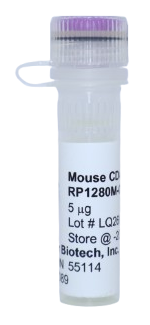
Mouse CD40 Ligand (TNFSF5) Recombinant Protein
- Catalog Number:
- RP1280M
- Availability:
- In stock
- Application:
- Cell Culture, Control, ELISA, ELISpot Control, Western Blot Control
- 100% Homology:
- Mus musculus (house mouse)
 Powered by Bioz
 - Mouse CD40 Ligand (CD40L, CD154) (catalog RP1280M) is a yeast-derived cytokine supplied lyophilized without carrier protein in 10% trehalose; it has no affinity tags and is naturally endotoxin-free, and should be reconstituted in sterile PBS that contains at least 0.1% carrier protein. The protein is ~16.4 kDa, 149 amino acids long (full sequence provided), and >98% pure by SDS-PAGE, with 100% amino-acid homology to house mouse. Store at -20°C (stable up to twelve months from date of receipt; working aliquots with carrier protein stable ~3 months) and avoid repeated freeze/thaw cycles. Product origin is the USA. It is commonly used to study CD40/CD40L signaling and immune responses (including activation of B cells, dendritic cells, and macrophages, as well as regulation of adaptive immunity); typical experimental uses include cell-culture stimulation and activation assays, cytokine and signaling studies, ELISA and neutralization assays, flow-cytometry and Western blot controls, and antibody generation/validation. Kingfisher Biotech products are supplied for research applications and are not intended for medicinal, diagnostic, or therapeutic use.
| Amino Acid Sequence | MQRGDEDPQI AAHVVSEANS NAASVLQWAK KGYYTMKSNL VMLENGKQLT VKREGLYYVY TQVTFCSNRE PSSQRPFIVG LWLKPSSGSE RILLKAANTH SSSQLCEQQS VHLGGVFELQ AGASVFVNVT EASQVIHRVG FSSFGLLKL (149) |
| Endotoxin | Naturally endotoxin-free |
| Form | Lyophilized |
| Storage Conditions | -20°C |
| Molecular Weight | 16.4 kDa |
| Purity | >98% as visualized by SDS-PAGE analysis. |
| Expression System | Yeast |
| Form | Lyophilized |
| Country Of Origin | USA |
Mouse CD40 Ligand (CD40L), also known as CD154 and encoded by the Cd40lg gene, is a type II transmembrane protein belonging to the tumor necrosis factor (TNF) superfamily, which includes related ligands such as TNF-α, CD27 ligand (CD70), OX40 ligand (CD252), and 4-1BB ligand (CD137L) that regulate immune activation and cell–cell communication. In mice (Mus musculus), CD40L is primarily expressed on activated CD4⁺ T lymphocytes, and can also be detected on platelets and other activated immune cells following antigen stimulation. CD40L binds to its receptor CD40, which is expressed on B cells, dendritic cells, macrophages, and other antigen-presenting cells, initiating intracellular signaling pathways such as NF-κB and MAPK that promote B-cell activation, proliferation, immunoglobulin class switching, germinal center formation, and the development of long-lived memory B cells. Through these mechanisms, mouse CD40L plays a critical role in T cell–dependent antibody responses and regulation of adaptive immunity. Because mice are the most widely used genetic model organism in immunology, CD40L has been extensively studied in knockout and transgenic mouse models to investigate T cell costimulation, humoral immunity, autoimmune disease, and host responses to infection, providing key insights into CD40–CD40L signaling and its role in immune regulation and immunotherapy development.
Citations
Please choose a size to see price
RELATED MEDIA
