Slide 1 of 1 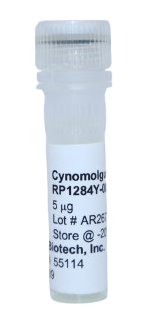
Cynomolgus Monkey CCL2 (MCP-1) Recombinant Protein
- Catalog Number:
- RP1284Y
- Availability:
- In stock
- Application:
- Cell Culture, Control, ELISA, ELISpot Control, Western Blot Control
- 100% Homology:
- Cercocebus atys (sooty mangabey), Chlorocebus sabaeus (green monkey), Macaca fascicularis (crab-eating macaque), Macaca mulatta (Rhesus monkey), Macaca nemestrina (pig-tailed macaque), Mandrillus leucophaeus (drill), Papio anubis (olive baboon), Pongo pygmaeus (Bornean orangutan), Rhinopithecus bieti (black snub-nosed monkey), Rhinopithecus roxellana (golden snub-nosed monkey)
 Powered by Bioz
 - Cynomolgus Monkey CCL2 (MCP-1, Monocyte Chemoattractant Protein-1) (catalog RP1284Y) is a yeast-derived chemokine supplied lyophilized without carrier protein in 10% trehalose; it has no affinity tags and is naturally endotoxin-free, and should be reconstituted in sterile PBS that contains at least 0.1% carrier protein. The protein is ~8.7 kDa, 76 amino acids long (full sequence provided), and >98% pure by SDS-PAGE, with amino-acid homology to crab-eating macaque, rhesus monkey, olive baboon, drill, pig-tailed macaque, and green monkey. Store at -20°C (stable up to twelve months from date of receipt; working aliquots with carrier protein stable ~3 months) and avoid repeated freeze/thaw cycles. Product origin is the USA. It is commonly used to study CCL2/MCP-1 signaling and immune-cell chemotaxis (including recruitment of monocytes and macrophages during inflammatory responses); typical experimental uses include cell-culture stimulation and migration assays, chemotaxis and signaling studies, ELISA and neutralization assays, flow-cytometry and Western blot controls, and antibody generation/validation. Kingfisher Biotech products are supplied for research applications and are not intended for medicinal, diagnostic, or therapeutic use.
| Amino Acid Sequence | QPDAINAPVT CCYNFTNRKI SVQRLASYRR ITSSKCPKEA VIFKTIVAKE ICADPKQKWV QDSMDHLDKQ IQTPKP (76) |
| Endotoxin | Naturally endotoxin-free |
| Form | Lyophilized |
| Storage Conditions | -20°C |
| Molecular Weight | 8.7 kDa |
| Purity | >98% as visualized by SDS-PAGE analysis. |
| Expression System | Yeast |
| Form | Lyophilized |
| Country Of Origin | USA |
Cynomolgus Monkey (Macaca fascicularis) CCL2 (C-C motif chemokine ligand 2, also known as monocyte chemoattractant protein-1, MCP-1) is a pro-inflammatory chemokine that plays a central role in recruitment and activation of monocytes, macrophages, dendritic cells, and memory T cells during immune responses. CCL2 primarily signals through the CCR2 receptor, activating intracellular pathways that promote leukocyte migration, cytokine production, and coordination of innate and adaptive immunity at sites of infection, inflammation, or tissue injury. Highly homologous to human CCL2, cynomolgus CCL2 is widely studied in nonhuman primate models of infectious and inflammatory diseases, including tuberculosis, dengue, influenza, and SARS-CoV-2, where it contributes to monocyte and macrophage recruitment to infected tissues and influences inflammatory disease progression. CCL2 also plays roles in atherosclerosis, autoimmune disease models, and cancer research, where monocyte-derived macrophages contribute to tissue remodeling and immune-mediated pathology. Because cynomolgus monkeys are extensively used in preclinical drug development and immunology research, characterization of CCL2 is important for evaluating chemokine-mediated immune cell trafficking, inflammatory responses, and the effects of anti-inflammatory or immunomodulatory therapeutics. As a biomarker of monocyte recruitment and inflammatory activation, cynomolgus CCL2 provides valuable translational insight into chemokine signaling pathways relevant to human disease.
Citations
Please choose a size to see price
RELATED MEDIA
