Slide 1 of 1 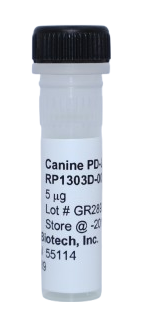
Canine PD-L1 Recombinant Protein
- Catalog Number:
- RP1303D
- Availability:
- In stock
- Application:
- Cell Culture, Control, ELISA, ELISpot Control, Western Blot Control
- 100% Homology:
- Canis lupus dingo (dingo), Canis lupus familiaris (dog)
 Powered by Bioz
 - Canine PD-L1 (Programmed Death-Ligand 1, CD274) (catalog RP1303D) is a yeast-derived immune checkpoint protein supplied lyophilized without carrier protein in 10% trehalose; it has no affinity tags and is naturally endotoxin-free, and should be reconstituted in sterile PBS that contains at least 0.1% carrier protein. The protein is ~24.7 kDa, 218 amino acids long (full sequence provided), and >98% pure by SDS-PAGE, with 100% amino-acid homology to dog and dingo. Store at -20°C (stable up to twelve months from date of receipt; working aliquots with carrier protein stable ~3 months) and avoid repeated freeze/thaw cycles. Product origin is the USA. It is commonly used to study PD-L1/PD-1 signaling and immune regulation (including modulation of T-cell activation and immune checkpoint pathways); typical experimental uses include cell-culture stimulation and binding assays, immune checkpoint and signaling studies, ELISA and neutralization assays, flow-cytometry and Western blot controls, and antibody generation/validation. Kingfisher Biotech products are supplied for research applications and are not intended for medicinal, diagnostic, or therapeutic use.
| Amino Acid Sequence | FTITVSKDLY VVEYGGNVTM ECKFPVEKQL NLFALIVYWE MEDKKIIQFV NGKEDLKVQH SSYSQRAQLL KDQLFLGKAA LQITDVRLQD AGVYCCLIGY GGADYKRITL KVHAPYRNIS QRISVDPVTS EHELMCQAEG YPEAEVIWTS SDHRVLSGKT TITNSNREEK LFNVTSTLNI NATANEIFYC TFQRSGPEEN NTAELVIPER LPVPASER (218) |
| Endotoxin | Naturally endotoxin-free |
| Form | Lyophilized |
| Storage Conditions | -20°C |
| Molecular Weight | 24.7 kDa |
| Purity | >98% as visualized by SDS-PAGE analysis. |
| Expression System | Yeast |
| Form | Lyophilized |
| Country Of Origin | USA |
Canine Programmed Death-Ligand 1 (PD-L1) (CD274, also known as B7-H1) is an immune checkpoint protein that plays a critical role in regulating T cell activation and immune tolerance in dogs (Canis lupus familiaris). PD-L1 is a member of the B7 family of immunoregulatory proteins, which includes molecules such as PD-L2 (CD273), CD80 (B7-1), and CD86 (B7-2) that regulate T cell costimulatory and coinhibitory signaling. PD-L1 is expressed on antigen-presenting cells such as macrophages and dendritic cells, as well as epithelial cells, endothelial cells, and various tumor cells, and interacts with its receptor PD-1 (Programmed Death-1, CD279) on activated T lymphocytes. Binding of PD-L1 to PD-1 delivers inhibitory signals that suppress T cell proliferation, cytokine production, and cytotoxic activity, helping to maintain immune homeostasis and limit excessive inflammatory responses. In canine health, PD-L1 expression has been reported in several canine cancers, including oral melanoma, osteosarcoma, mast cell tumors, and lymphoma, where tumor-associated PD-L1 expression can contribute to immune evasion by inhibiting anti-tumor T cell responses. PD-L1 signaling may also regulate immune responses during chronic infections and inflammatory diseases. Because the PD-1/PD-L1 pathway is a major target of immune checkpoint therapy in human oncology, canine PD-L1 is increasingly studied in comparative oncology and veterinary immunotherapy, supporting development of checkpoint inhibitor therapies and improved understanding of tumor–immune system interactions in dogs.
Citations
Please choose a size to see price
RELATED MEDIA
