Slide 1 of 1 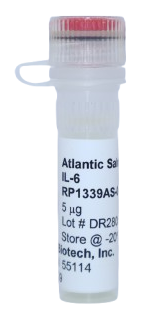
Atlantic Salmon IL-6 Recombinant Protein
- Catalog Number:
- RP1339AS
- Availability:
- In stock
- Application:
- Cell Culture, Control, ELISA, ELISpot Control, Western Blot Control
- 100% Homology:
- Salmo salar (Atlantic salmon)
 Powered by Bioz
 - Atlantic Salmon IL-6 (Interleukin-6) (catalog RP1339AS) is a yeast-derived cytokine supplied lyophilized without carrier protein in 10% trehalose; it has no affinity tags and is naturally endotoxin-free, and should be reconstituted in sterile PBS that contains at least 0.1% carrier protein. The protein is ~22.9 kDa, 202 amino acids long (full sequence provided), and >98% pure by SDS-PAGE, with 100% amino-acid homology to Atlantic salmon. Store at -20°C (stable up to twelve months from date of receipt; working aliquots with carrier protein stable ~3 months) and avoid repeated freeze/thaw cycles. Product origin is the USA. It is commonly used to study IL-6 signaling and immune responses (including regulation of inflammation, acute-phase responses, and cytokine production); typical experimental uses include cell-culture stimulation and dosing studies, cytokine signaling assays, ELISA and neutralization assays, flow-cytometry and Western blot controls, and antibody generation/validation. Kingfisher Biotech products are supplied for research applications and are not intended for medicinal, diagnostic, or therapeutic use.
| Amino Acid Sequence | SPVPSALSEL MTSGWTSGEE LATDSLYGET GAPPKWEQII KMLVHEVTTL RNQQFVEEFQ KPVEEISSFS QHQVLSTPPH LSKTLCSTTN KEACLQEIRR GLRVYQLLLQ HVKAEYPQST LLPSVTHQTT VLIGLVKDQM KAAEVVEDLS ASERERVLGE VSTGTEWERK TSVHAILREL RNFLVDTKRA LRRMEKRGKD FQ (202) |
| Endotoxin | Naturally endotoxin-free |
| Form | Lyophilized |
| Storage Conditions | -20°C |
| Molecular Weight | 22.9 kDa |
| Purity | >98% as visualized by SDS-PAGE analysis. |
| Expression System | Yeast |
| Form | Lyophilized |
| Country Of Origin | USA |
Atlantic Salmon (Salmo salar) Interleukin-6 (IL-6) is a pro-inflammatory cytokine that plays a central role in regulating innate and adaptive immune responses in teleost fish. Although structurally divergent from mammalian IL-6, salmon IL-6 shares functional similarities, including activation of JAK/STAT signaling pathways through gp130-like receptor components and induction of acute-phase responses, leukocyte activation, and inflammatory gene expression. In Atlantic salmon, IL-6 expression is rapidly upregulated in response to bacterial infections such as Aeromonas salmonicida and Vibrio species, viral pathogens including infectious salmon anemia virus (ISAV) and piscine orthoreovirus (PRV), and parasitic challenges such as sea lice (Lepeophtheirus salmonis). Elevated IL-6 levels are associated with systemic inflammation, modulation of macrophage and lymphocyte activity, and coordination of mucosal immune responses in gill, skin, and gut tissues—key barriers in aquatic environments. As an important biomarker of immune activation, salmon IL-6 is widely used in aquaculture research to evaluate vaccine efficacy, disease resistance, stress responses, and the impact of environmental conditions on fish health. Characterization of Atlantic salmon IL-6 supports improved understanding of teleost immunology, host-pathogen interactions in aquatic systems, and development of immunomodulatory strategies to enhance fish welfare, productivity, and sustainability in commercial aquaculture.
Citations
Please choose a size to see price
RELATED MEDIA
