Slide 1 of 1 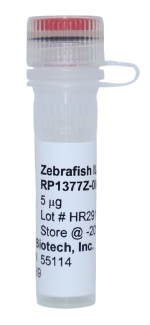
Zebrafish IL-8 Recombinant Protein
- Catalog Number:
- RP1377Z
- Availability:
- In stock
- Application:
- Cell Culture, Control, ELISA, ELISpot Control, Western Blot Control
- 100% Homology:
- Danio rerio (zebrafish)
 Powered by Bioz
 - Zebrafish IL-8 (CXCL8, Interleukin-8) (catalog RP1377Z) is a yeast-derived chemokine supplied lyophilized without carrier protein in 10% trehalose; it has no affinity tags and is naturally endotoxin-free, and should be reconstituted in sterile PBS that contains at least 0.1% carrier protein. The protein is ~8.6 kDa, 76 amino acids long (full sequence provided), and >98% pure by SDS-PAGE, with 100% amino-acid homology to zebrafish. Store at -20°C (stable up to twelve months from date of receipt; working aliquots with carrier protein stable ~3 months) and avoid repeated freeze/thaw cycles. Product origin is the USA. It is commonly used to study IL-8/CXCL8 signaling and immune-cell chemotaxis (including recruitment and activation of neutrophils during inflammatory responses); typical experimental uses include cell-culture stimulation and migration assays, chemotaxis and signaling studies, ELISA and neutralization assays, flow-cytometry and Western blot controls, and antibody generation/validation. Kingfisher Biotech products are supplied for research applications and are not intended for medicinal, diagnostic, or therapeutic use.
| Amino Acid Sequence | MSLRGLAVDP RCRCIETESR RIGKHIKSVE LFPPSPHCKD LEIIATLMTT GQEICLDPSA PWVKKIIDRI IVNRKP (76) |
| Endotoxin | Naturally endotoxin-free |
| Form | Lyophilized |
| Storage Conditions | -20°C |
| Molecular Weight | 8.6 kDa |
| Purity | >98% as visualized by SDS-PAGE analysis. |
| Expression System | Yeast |
| Form | Lyophilized |
| Country Of Origin | USA |
Zebrafish (Danio rerio) Interleukin-8 (IL-8), commonly referred to as Cxcl8 (with duplicated paralogs such as cxcl8a and cxcl8b in teleosts), is a key pro-inflammatory chemokine that regulates neutrophil recruitment and activation during innate immune responses. Functionally analogous to mammalian IL-8, zebrafish IL-8 is rapidly induced in response to bacterial infections (e.g., Mycobacterium marinum, Streptococcus spp.), viral challenges, tissue injury, and inflammatory stimuli, and signals through CXCR1- and CXCR2-like receptors to promote directed neutrophil migration to sites of infection or damage. Due to the optical transparency of zebrafish larvae and availability of fluorescent neutrophil reporter lines, IL-8–mediated chemotaxis can be visualized in real time, making zebrafish a powerful in vivo model for studying leukocyte trafficking, wound healing, granuloma formation, and tumor-associated inflammation. Dysregulated IL-8/CXCR signaling has been implicated in chronic inflammation and cancer progression in zebrafish models. As both a biomarker and functional mediator of neutrophil-driven inflammation, zebrafish IL-8 supports high-throughput drug screening, genetic manipulation studies, and comparative immunology research, reinforcing its value as a versatile vertebrate model for investigating chemokine biology and inflammatory disease mechanisms.
Citations
Please choose a size to see price
RELATED MEDIA
