Slide 1 of 1 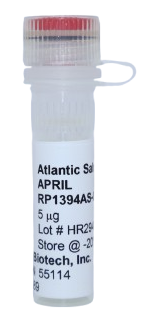
Atlantic Salmon APRIL Recombinant Protein
- Catalog Number:
- RP1394AS
- Availability:
- In stock
- Application:
- Cell Culture, Control, ELISA, ELISpot Control, Western Blot Control
- 100% Homology:
- Salmo salar (Atlantic salmon)
 Powered by Bioz
 - Atlantic Salmon APRIL (A Proliferation-Inducing Ligand, TNFSF13) (catalog RP1394AS) is a yeast-derived cytokine supplied lyophilized without carrier protein in 10% trehalose; it has no affinity tags and is naturally endotoxin-free, and should be reconstituted in sterile PBS that contains at least 0.1% carrier protein. The protein is ~15.3 kDa, 136 amino acids long (full sequence provided), and >98% pure by SDS-PAGE, with 100% amino-acid homology to Atlantic salmon. Store at -20°C (stable up to twelve months from date of receipt; working aliquots with carrier protein stable ~3 months) and avoid repeated freeze/thaw cycles. Product origin is the USA. It is commonly used to study APRIL/TNFSF13 signaling and immune regulation (including B-cell survival, proliferation, and antibody responses); typical experimental uses include cell-culture stimulation and activation assays, cytokine signaling studies, ELISA and neutralization assays, flow-cytometry and Western blot controls, and antibody generation/validation. Kingfisher Biotech products are supplied for research applications and are not intended for medicinal, diagnostic, or therapeutic use.
| Amino Acid Sequence | AFLHLVPLSS HSYDEDDYTL VEWAQGLSRL GEGLQVFGEK VTVVTEGTYF IYSQVLYKDT TWTMGHVIKK RLHGIETILM KCIQSMPSNI TVAQNTCYTA GVHYLEPGST LELSIPRKSA GLVLKPHSTF LGMFRI (136) |
| Endotoxin | Naturally endotoxin-free |
| Form | Lyophilized |
| Storage Conditions | -20°C |
| Molecular Weight | 15.3 kDa |
| Purity | >98% as visualized by SDS-PAGE analysis. |
| Expression System | Yeast |
| Form | Lyophilized |
| Country Of Origin | USA |
Salmon APRIL (A Proliferation-Inducing Ligand), also known as TNFSF13, is a member of the tumor necrosis factor (TNF) superfamily that plays a role in B cell survival, plasma cell differentiation, and regulation of humoral immunity in salmonid species (e.g., Atlantic salmon, Salmo salar). APRIL is expressed primarily by myeloid-lineage cells and lymphoid tissues, including the head kidney and spleen, which serve as major immune organs in teleost fish. Through interaction with receptors homologous to mammalian TACI and BCMA, salmon APRIL contributes to B cell maturation, antibody production, and maintenance of antibody-secreting cells. In teleost fish, APRIL is particularly important for mucosal immunity, supporting IgM and IgT/IgZ responses in gill, gut, and skin tissues that act as primary barriers against aquatic pathogens. Expression of APRIL may increase during bacterial, viral, or parasitic infections, as well as following vaccination. In aquaculture and comparative immunology research, salmon APRIL is studied in the context of vaccine efficacy, resistance to pathogens such as Aeromonas salmonicida, infectious salmon anemia virus (ISAV), and sea lice infestation, and for its role in adaptive immune regulation in teleost fish. Characterizing APRIL function in salmon provides valuable insight into the evolution of B cell–mediated immunity and supports strategies to enhance disease resistance in aquaculture systems.
Citations
Please choose a size to see price
RELATED MEDIA
