Slide 1 of 1 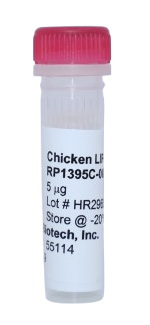
Chicken Leukemia Inhibitory Factor (LIF) Recombinant Protein
- Catalog Number:
- RP1395C
- Availability:
- In stock
- Application:
- Cell Culture, Control, ELISA, ELISpot Control, Western Blot Control
- 100% Homology:
- Gallus gallus (chicken)
 Powered by Bioz
 - Chicken LIF (Leukemia Inhibitory Factor) (catalog RP1395C) is a yeast-derived cytokine supplied lyophilized without carrier protein in 10% trehalose; it has no affinity tags and is naturally endotoxin-free, and should be reconstituted in sterile PBS that contains at least 0.1% carrier protein. The protein is ~21.0 kDa, 187 amino acids long (full sequence provided), and >98% pure by SDS-PAGE, with 100% amino-acid homology to chicken. Store at -20°C (stable up to twelve months from date of receipt; working aliquots with carrier protein stable ~3 months) and avoid repeated freeze/thaw cycles. Product origin is the USA. It is commonly used to study LIF signaling and cellular processes (including regulation of cell differentiation, stem cell maintenance, and cytokine-mediated signaling pathways); typical experimental uses include cell-culture stimulation and differentiation assays, cytokine signaling studies, ELISA and neutralization assays, flow-cytometry and Western blot controls, and antibody generation/validation. Kingfisher Biotech products are supplied for research applications and are not intended for medicinal, diagnostic, or therapeutic use.
| Amino Acid Sequence | RALLGTSSAC PTNGLCRANV LEQTRRQVAL LNATAQDLFS LYLKCQGEPF SSESDRLCSP SGIFFPPFHV NRTTERKEVM VAMYKLFAFL NASLGNITRD QEELNPMAKE LLNRLHNTTK TTRGLISNLT CLLCKHYNIF QVDVSYGESS KDKSAFKKKQ QGCQVLRKYV QVIAQAARVL LPHLSPA (187) |
| Endotoxin | Naturally endotoxin-free |
| Form | Lyophilized |
| Storage Conditions | -20°C |
| Molecular Weight | 21.0 kDa |
| Purity | >98% as visualized by SDS-PAGE analysis. |
| Expression System | Yeast |
| Form | Lyophilized |
| Country Of Origin | USA |
Chicken Leukemia Inhibitory Factor (LIF) is a multifunctional cytokine belonging to the IL-6 family—which in mammals includes IL-6, IL-11, oncostatin M (OSM), ciliary neurotrophic factor (CNTF), cardiotrophin-1 (CT-1), cardiotrophin-like cytokine factor 1 (CLCF1), and IL-27—all of which signal through receptor complexes containing the shared gp130 subunit. In chickens (Gallus gallus), LIF binds to the LIF receptor (LIFR) in association with gp130, activating JAK/STAT3, MAPK, and PI3K signaling pathways that regulate cell survival, differentiation, and immune modulation. Avian LIF plays important roles in embryonic development, hematopoiesis, and maintenance of pluripotency in early embryonic cells, and has been studied in the context of avian stem cell biology and primordial germ cell culture. In poultry health, LIF may contribute to regulation of inflammatory responses during infections such as avian influenza virus, Newcastle disease virus, and bacterial challenges, where STAT3-mediated signaling influences tissue repair and immune balance. Dysregulated LIF expression could impact fibrosis, tumor development (e.g., Marek’s disease), or chronic inflammation. As both a developmental and immunomodulatory cytokine, chicken LIF is relevant in studies of embryo culture systems, vaccine responses, oncogenic viral disease, and cytokine network regulation. Characterization of chicken LIF supports research into avian developmental biology, immune regulation, and comparative IL-6 family signaling across vertebrate species.
Citations
Please choose a size to see price
RELATED MEDIA
