Slide 1 of 1 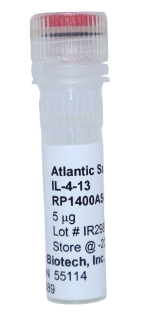
Atlantic Salmon IL-4-13 Recombinant Protein
- Catalog Number:
- RP1400AS
- Availability:
- In stock
- Application:
- Cell Culture, Control, ELISA, ELISpot Control, Western Blot Control
- 100% Homology:
- Salmo salar (Atlantic salmon)
 Powered by Bioz
 - Atlantic Salmon IL-4/13 (Interleukin-4/13) (catalog RP1400AS) is a yeast-derived cytokine supplied lyophilized without carrier protein in 10% trehalose; it has no affinity tags and is naturally endotoxin-free, and should be reconstituted in sterile PBS that contains at least 0.1% carrier protein. The protein is ~13.5 kDa, 117 amino acids long (full sequence provided), and >98% pure by SDS-PAGE, with 100% amino-acid homology to Atlantic salmon. Store at -20°C (stable up to twelve months from date of receipt; working aliquots with carrier protein stable ~3 months) and avoid repeated freeze/thaw cycles. Product origin is the USA. It is commonly used to study IL-4/13 signaling and immune responses (including regulation of Th2-type immune pathways, inflammation, and cytokine-mediated signaling); typical experimental uses include cell-culture stimulation and cytokine assays, signaling studies, ELISA and neutralization assays, flow-cytometry and Western blot controls, and antibody generation/validation. Kingfisher Biotech products are supplied for research applications and are not intended for medicinal, diagnostic, or therapeutic use.
| Amino Acid Sequence | YRQHKNHHSN LEAIISMAEQ YTHNLTEDLL RTLLIDVTHL TGTTTKCKEF FCEAEKILAS VKNATFGNIV RHLRVYNKHQ YCIVVKSQDN QAEGNQVELR RLLLDLKECG QKINSKP (117) |
| Endotoxin | Naturally endotoxin-free |
| Form | Lyophilized |
| Storage Conditions | -20°C |
| Molecular Weight | 13.5 kDa |
| Purity | >98% as visualized by SDS-PAGE analysis. |
| Expression System | Yeast |
| Form | Lyophilized |
| Country Of Origin | USA |
Atlantic Salmon (Salmo salar) Interleukin-4/13 (IL-4/13)–like cytokines are type 2–associated immune mediators that share functional homology with mammalian IL-4 and IL-13 and play important roles in regulating humoral immunity, macrophage polarization, and mucosal inflammatory responses in teleost fish. Due to genome duplication events in salmonids, Atlantic salmon possess multiple IL-4/13–like paralogs that signal through receptor complexes homologous to IL-4Rα/IL-13R–type chains, activating STAT6-dependent pathways that promote alternative (M2-like) macrophage activation, modulation of pro-inflammatory cytokine production, and support of epithelial barrier function. In salmon health, IL-4/13–like cytokines are particularly relevant in responses to parasitic infections such as Lepeophtheirus salmonis (sea lice), as well as bacterial pathogens like Aeromonas salmonicida and Piscirickettsia salmonis, where balanced type 2 responses contribute to tissue repair and regulation of excessive inflammation. Dysregulated expression may influence susceptibility to chronic inflammation or impaired pathogen clearance. As biomarkers of type 2–like immune polarization, Atlantic salmon IL-4/13–like cytokines are important in vaccine development, aquaculture disease management, and studies of host–pathogen interactions. Characterization of these cytokines supports comparative immunology research into the evolution of Th2-type immunity and informs strategies to enhance disease resistance and fish welfare in commercial aquaculture systems.
Citations
Please choose a size to see price
RELATED MEDIA
