Slide 1 of 1 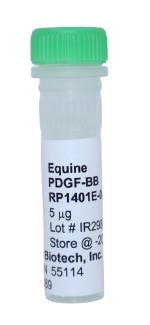
Equine PDGF-BB Recombinant Protein
- Catalog Number:
- RP1401E
- Availability:
- In stock
- Application:
- Cell Culture, Control, ELISA, ELISpot Control, Western Blot Control
- 100% Homology:
- Equus asinus (ass), Equus caballus (horse), Equus przewalskii (Przewalski's horse)
 Powered by Bioz
 - Equine PDGF-BB (Platelet-Derived Growth Factor-BB) (catalog RP1401E) is a yeast-derived growth factor supplied lyophilized without carrier protein in 10% trehalose; it has no affinity tags and is naturally endotoxin-free, and should be reconstituted in sterile PBS that contains at least 0.1% carrier protein. The protein is ~12.2 kDa (monomer), 109 amino acids long (full sequence provided), and >98% pure by SDS-PAGE, with 100% amino-acid homology to horse, ass, and Przewalski's horse. Store at -20°C (stable up to twelve months from date of receipt; working aliquots with carrier protein stable ~3 months) and avoid repeated freeze/thaw cycles. Product origin is the USA. It is commonly used to study PDGF signaling and cellular processes (including regulation of cell proliferation, migration, and wound healing); typical experimental uses include cell-culture stimulation and proliferation assays, signaling studies, ELISA and neutralization assays, flow-cytometry and Western blot controls, and antibody generation/validation. Kingfisher Biotech products are supplied for research applications and are not intended for medicinal, diagnostic, or therapeutic use.
| Amino Acid Sequence | SLGSLAVAEP AMIAECKTRT EVFEISRRLI DRTNANFLVW PPCVEVQRCS GCCNNRHVQC RPTQVQLRPV QVRKIEIVRK KPTFKKATVT LEDHLACKCE TVGAARPVT (109) |
| Endotoxin | Naturally endotoxin-free |
| Form | Lyophilized |
| Storage Conditions | -20°C |
| Molecular Weight | 12.2 kDa (monomer) |
| Purity | >98% as visualized by SDS-PAGE analysis. |
| Expression System | Yeast |
| Form | Lyophilized |
| Country Of Origin | USA |
Equine Platelet-Derived Growth Factor-BB (PDGF-BB) is a homodimeric growth factor composed of two PDGF-B chains that plays a key role in cell proliferation, migration, angiogenesis, and tissue repair in horses (Equus caballus). PDGF-BB signals primarily through platelet-derived growth factor receptor-β (PDGFR-β) and PDGFR-α/β receptor complexes, activating downstream signaling pathways including PI3K/AKT, MAPK, and STAT, which regulate fibroblast activation, smooth muscle cell proliferation, and extracellular matrix production. In horses, PDGF-BB is produced by platelets, macrophages, endothelial cells, and fibroblasts and is released during tissue injury, inflammation, and wound healing. It plays particularly important roles in musculoskeletal tissue repair, including healing of tendons, ligaments, cartilage, and bone, which are critical tissues in equine athletic performance. PDGF-BB also contributes to dermal wound healing and vascular remodeling, promoting fibroblast migration and angiogenesis at sites of injury. Because of its regenerative properties, PDGF-BB is widely studied in equine regenerative medicine, including platelet-rich plasma (PRP) therapies used to treat tendon and ligament injuries. As a regulator of cellular growth, angiogenesis, and tissue remodeling, equine PDGF-BB is important for studies of wound healing, musculoskeletal injury repair, and regenerative therapies relevant to equine health and performance.
Citations
Please choose a size to see price
RELATED MEDIA
