Slide 1 of 1 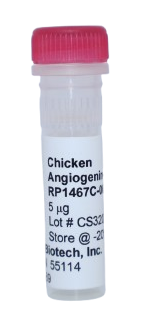
Chicken Angiogenin-1 (Ang-1) Recombinant Protein
- Catalog Number:
- RP1467C
- Availability:
- In stock
- Application:
- Cell Culture, Control, ELISA, ELISpot Control, Western Blot Control
- 100% Homology:
- Gallus gallus (chicken)
 Powered by Bioz
 - Chicken Ang-1 (Angiopoietin-1) (catalog RP1467C) is a yeast-derived growth factor supplied lyophilized without carrier protein in 10% trehalose; it has no affinity tags and is naturally endotoxin-free, and should be reconstituted in sterile PBS that contains at least 0.1% carrier protein. The protein is ~13.2 kDa, 116 amino acids long (full sequence provided), and >98% pure by SDS-PAGE, with 100% amino-acid homology to chicken. Store at -20°C (stable up to twelve months from date of receipt; working aliquots with carrier protein stable ~3 months) and avoid repeated freeze/thaw cycles. Product origin is the USA. It is commonly used to study Ang-1 signaling and vascular biology (including regulation of angiogenesis, vascular stability, and endothelial cell survival); typical experimental uses include cell-culture stimulation and angiogenesis assays, signaling studies, ELISA and neutralization assays, flow-cytometry and Western blot controls, and antibody generation/validation. Kingfisher Biotech products are supplied for research applications and are not intended for medicinal, diagnostic, or therapeutic use.
| Amino Acid Sequence | VPTYQDFLRT HVDFPKTSFP NIAAYCNVMM VRRGINVHGR CKSLNTFVHT DPRNLNTLCI NQPNRALRTT QQQLPVTDCK LIRSHPTCSY TGNQFNHRVR VGCWGGLPVH LDGTFP (116) |
| Endotoxin | Naturally endotoxin-free |
| Form | Lyophilized |
| Storage Conditions | -20°C |
| Molecular Weight | 13.2 kDa |
| Purity | >98% as visualized by SDS-PAGE analysis. |
| Expression System | Yeast |
| Form | Lyophilized |
| Country Of Origin | USA |
Chicken angiogenin (ANG) is a secreted ribonuclease belonging to the RNase A superfamily that plays a role in angiogenesis, vascular development, and tissue remodeling. In chickens (Gallus gallus), angiogenin is produced by endothelial cells, epithelial cells, and other stromal cell populations, where it promotes endothelial cell proliferation, migration, and capillary formation through activation of pro-angiogenic signaling pathways and regulation of ribosomal RNA transcription. In addition to its vascular functions, avian angiogenin may contribute to embryonic development, tissue repair, and modulation of inflammatory responses. Baseline expression in healthy chickens is generally low to moderate and varies with developmental stage, but levels may increase during embryogenesis, wound healing, inflammatory stimulation, tumor growth, or hypoxic stress. In poultry science and avian developmental research, chicken angiogenin is of interest in studies of embryonic vascular formation, skeletal muscle development, wound repair, tumor angiogenesis, and growth regulation. Characterizing angiogenin expression in chickens provides valuable insight into mechanisms of vascular biology, developmental regulation, and angiogenesis-related processes in avian and comparative research settings.
Citations
Please choose a size to see price
RELATED MEDIA
