Slide 1 of 1 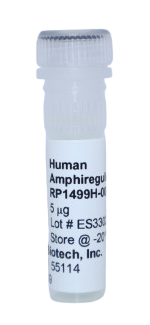
Human Amphiregulin Recombinant Protein
- Catalog Number:
- RP1499H
- Availability:
- In stock
- Application:
- Cell Culture, Control, ELISA, ELISpot Control, Western Blot Control
- 100% Homology:
- Homo sapiens (human)
 Powered by Bioz
 - Human Amphiregulin (AR) (catalog RP1499H) is a yeast-derived growth factor supplied lyophilized without carrier protein in 10% trehalose; it has no affinity tags and is naturally endotoxin-free, and should be reconstituted in sterile PBS that contains at least 0.1% carrier protein. The protein is ~11.3 kDa, 98 amino acids long (full sequence provided), and >98% pure by SDS-PAGE, with 100% amino-acid homology to human. Store at -20°C (stable up to twelve months from date of receipt; working aliquots with carrier protein stable ~3 months) and avoid repeated freeze/thaw cycles. Product origin is the USA. It is commonly used to study amphiregulin/EGFR signaling and cellular processes (including regulation of cell proliferation, differentiation, tissue repair, and inflammatory responses); typical experimental uses include cell-culture stimulation and growth assays, signaling studies, ELISA and neutralization assays, flow-cytometry and Western blot controls, and antibody generation/validation. Kingfisher Biotech products are supplied for research applications and are not intended for medicinal, diagnostic, or therapeutic use.
| Amino Acid Sequence | SVRVEQVVKP PQNKTESENT SDKPKRKKKG GKNGKNRRNR KKKNPCNAEF QNFCIHGECK YIEHLEAVTC KCQQEYFGER CGEKSMKTHS MIDSSLSK (98) |
| Endotoxin | Naturally endotoxin-free |
| Form | Lyophilized |
| Storage Conditions | -20°C |
| Molecular Weight | 11.3 kDa |
| Purity | >98% as visualized by SDS-PAGE analysis. |
| Expression System | Yeast |
| Form | Lyophilized |
| Country Of Origin | USA |
Human amphiregulin (AREG) is a member of the epidermal growth factor (EGF) family and functions as a ligand for the epidermal growth factor receptor (EGFR/ErbB1), where it regulates epithelial cell proliferation, differentiation, survival, and tissue repair. Amphiregulin is produced by a variety of cell types including epithelial cells, fibroblasts, keratinocytes, smooth muscle cells, and activated immune cells such as Th2 cells, regulatory T cells (Tregs), innate lymphoid cells (ILC2s), and mast cells, particularly in response to tissue injury, inflammation, and allergic stimulation. Through activation of EGFR signaling pathways (including MAPK and PI3K/AKT), amphiregulin contributes to wound healing, mucosal barrier integrity, and tissue remodeling, but dysregulated expression has been associated with chronic inflammatory diseases, fibrosis, and tumor progression. Elevated amphiregulin levels have been reported in conditions such as asthma, atopic dermatitis, chronic obstructive pulmonary disease (COPD), inflammatory bowel disease (IBD), rheumatoid arthritis, and multiple cancers including colorectal, breast, lung, and head and neck carcinomas. As both a mediator of tissue repair and a driver of EGFR-dependent oncogenic signaling, human amphiregulin serves as an important biomarker and potential therapeutic target in inflammatory disease, regenerative medicine, and oncology research.
Citations
Please choose a size to see price
RELATED MEDIA
