Slide 1 of 1 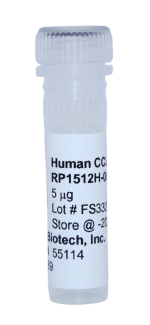
Human CCL21 Recombinant Protein
- Catalog Number:
- RP1512H
- Availability:
- In stock
- Application:
- Cell Culture, Control, ELISA, ELISpot Control, Western Blot Control
- 100% Homology:
- Homo sapiens (human), Pan paniscus (pygmy chimpanzee), Pan troglodytes (chimpanzee)
 Powered by Bioz
 - Human CCL21 (Secondary Lymphoid Tissue Chemokine, SLC; 6Ckine) (catalog RP1512H) is a yeast-derived chemokine supplied lyophilized without carrier protein in 10% trehalose; it has no affinity tags and is naturally endotoxin-free, and should be reconstituted in sterile PBS that contains at least 0.1% carrier protein. The protein is ~12.3 kDa, 111 amino acids long (full sequence provided), and >98% pure by SDS-PAGE, with 100% amino-acid homology to human, pygmy chimpanzee, and chimpanzee. Store at -20°C (stable up to twelve months from date of receipt; working aliquots with carrier protein stable ~3 months) and avoid repeated freeze/thaw cycles. Product origin is the USA. It is commonly used to study CCL21/SLC signaling and immune-cell trafficking (including migration of T cells and dendritic cells to lymphoid tissues via CCR7 signaling); typical experimental uses include cell-culture stimulation and migration assays, chemotaxis and signaling studies, ELISA and neutralization assays, flow-cytometry and Western blot controls, and antibody generation/validation. Kingfisher Biotech products are supplied for research applications and are not intended for medicinal, diagnostic, or therapeutic use.
| Amino Acid Sequence | SDGGAQDCCL KYSQRKIPAK VVRSYRKQEP SLGCSIPAIL FLPRKRSQAE LCADPKELWV QQLMQHLDKT PSPQKPAQGC RKDRGASKTG KKGKGSKGCK RTERSQTPKG P (111) |
| Endotoxin | Naturally endotoxin-free |
| Form | Lyophilized |
| Storage Conditions | -20°C |
| Molecular Weight | 12.3 kDa |
| Purity | >98% as visualized by SDS-PAGE analysis. |
| Expression System | Yeast |
| Form | Lyophilized |
| Country Of Origin | USA |
Human CCL21 (C-C motif chemokine ligand 21, also known as secondary lymphoid-tissue chemokine, SLC, or 6Ckine) is a homeostatic chemokine that plays a critical role in lymphocyte trafficking and organization of adaptive immune responses. CCL21 primarily signals through the CCR7 receptor, directing the migration of naïve T cells, central memory T cells, and mature dendritic cells to secondary lymphoid organs such as lymph nodes, spleen, and Peyer’s patches. In humans, CCL21 is produced mainly by stromal cells and high endothelial venules within lymphoid tissues, where it establishes chemokine gradients that guide immune cells into T-cell zones and facilitate interactions between antigen-presenting dendritic cells and lymphocytes required for activation of adaptive immunity. CCL21-mediated CCR7 signaling is essential for immune surveillance, lymph node organization, and efficient antigen presentation during infection. Dysregulation of CCL21 expression has been associated with chronic inflammatory diseases, autoimmune disorders, and cancer, where altered chemokine gradients can influence immune cell infiltration and tumor microenvironment dynamics. Because of its central role in lymphoid tissue organization and immune cell trafficking, human CCL21 is widely studied in vaccine responses, tumor immunology, and immune-mediated disease, and is being explored as a potential therapeutic target for enhancing immune activation or modulating inflammation.
Citations
Please choose a size to see price
RELATED MEDIA
