Slide 1 of 1 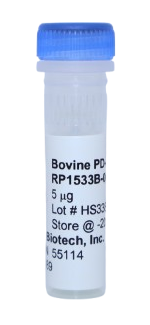
Bovine PD-L1 Recombinant Protein
- Catalog Number:
- RP1533B
- Availability:
- In stock
- Application:
- Cell Culture, Control, ELISA, ELISpot Control, Western Blot Control
- 100% Homology:
- Bison bison bison (American buffalo), Bos indicus (zebu), Bos mutus (wild yak), Bos taurus (cattle)
 Powered by Bioz
 - Bovine PD-L1 (Programmed Death-Ligand 1, CD274) (catalog RP1533B) is a yeast-derived immune checkpoint protein supplied lyophilized without carrier protein in 10% trehalose; it has no affinity tags and is naturally endotoxin-free, and should be reconstituted in sterile PBS that contains at least 0.1% carrier protein. The protein is ~25.1 kDa, 220 amino acids long (full sequence provided), and >98% pure by SDS-PAGE, with 100% amino-acid homology to cattle, American buffalo, zebu, and wild yak. Store at -20°C (stable up to twelve months from date of receipt; working aliquots with carrier protein stable ~3 months) and avoid repeated freeze/thaw cycles. Product origin is the USA. It is commonly used to study PD-L1 signaling and immune regulation (including inhibition of T-cell activation and modulation of immune checkpoint pathways via PD-1 interaction); typical experimental uses include cell-culture stimulation and binding assays, immune checkpoint and signaling studies, ELISA and neutralization assays, flow-cytometry and Western blot controls, and antibody generation/validation. Kingfisher Biotech products are supplied for research applications and are not intended for medicinal, diagnostic, or therapeutic use.
| Amino Acid Sequence | FTITVSKDLY VVEYGSNVTL ECRFPVDKQL NLLVLVVYWE MEDKKIIQFV NGKEDPNVQH SSYHGRAQLL KDQLFLGKAA LQITDVKLQD AGVYCCLISY GGADYKRITL KVNAPYRKIY HTISVDPVTS EHELTCQAEG YPEADVIWTS SDHQVLSGKT SITSSKREEK LFNVTSTLRI NTTADKIFYC TFRRLGHEEN NTAELVIPEP YLDPAKKRNH (220) |
| Endotoxin | Naturally endotoxin-free |
| Form | Lyophilized |
| Storage Conditions | -20°C |
| Molecular Weight | 25.1 kDa |
| Purity | >98% as visualized by SDS-PAGE analysis. |
| Expression System | Yeast |
| Form | Lyophilized |
| Country Of Origin | USA |
Bovine Programmed Death-Ligand 1 (PD-L1) (also known as CD274 or B7-H1) is an immune checkpoint protein that plays an important role in regulating T cell activation and immune tolerance in cattle (Bos taurus). PD-L1 is expressed on antigen-presenting cells such as macrophages and dendritic cells, as well as epithelial cells, endothelial cells, and some tumor or infected cells, and interacts with its receptor PD-1 (Programmed Death-1, CD279) on activated T lymphocytes. Engagement of PD-L1 with PD-1 delivers inhibitory signals that suppress T cell proliferation, cytokine production, and cytotoxic activity, helping to maintain immune homeostasis and prevent excessive inflammatory responses. In cattle, PD-L1 signaling has been associated with immune regulation during chronic infectious diseases, including bovine leukemia virus (BLV) infection, bovine tuberculosis caused by Mycobacterium bovis, and Johne’s disease caused by Mycobacterium avium subsp. paratuberculosis, where increased PD-L1 expression can contribute to T cell exhaustion and reduced pathogen clearance. PD-L1 is also involved in controlling inflammatory responses during infection and tissue damage. Because immune checkpoint pathways influence host immunity and pathogen persistence, bovine PD-L1 is an important target of study in veterinary immunology, chronic infection research, and development of immunotherapeutic or vaccine strategies aimed at improving disease resistance in cattle.
Citations
Please choose a size to see price
RELATED MEDIA
