Slide 1 of 1 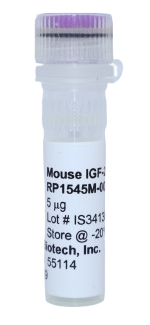
Mouse IGF-2 Recombinant Protein
- Catalog Number:
- RP1545M
- Availability:
- In stock
- Application:
- Cell Culture, Control, ELISA, ELISpot Control, Western Blot Control
- 100% Homology:
- Mus musculus (house mouse)
 Powered by Bioz
 - Mouse IGF-2 (Insulin-like Growth Factor 2) (catalog RP1545M) is a yeast-derived growth factor supplied lyophilized without carrier protein in 10% trehalose; it has no affinity tags and is naturally endotoxin-free, and should be reconstituted in sterile PBS that contains at least 0.1% carrier protein. The protein is ~7.4 kDa, 67 amino acids long (full sequence provided), and >98% pure by SDS-PAGE, with 100% amino-acid homology to house mouse. Store at -20°C (stable up to twelve months from date of receipt; working aliquots with carrier protein stable ~3 months) and avoid repeated freeze/thaw cycles. Product origin is the USA. It is commonly used to study IGF-2 signaling and cellular processes (including regulation of cell growth, proliferation, differentiation, and development); typical experimental uses include cell-culture stimulation and growth assays, signaling studies, ELISA and neutralization assays, flow-cytometry and Western blot controls, and antibody generation/validation. Kingfisher Biotech products are supplied for research applications and are not intended for medicinal, diagnostic, or therapeutic use.
| Amino Acid Sequence | AYGPGETLCG GELVDTLQFV CSDRGFYFSR PSSRANRRSR GIVEECCFRS CDLALLETYC ATPAKSE (67) |
| Endotoxin | Naturally endotoxin-free |
| Form | Lyophilized |
| Storage Conditions | -20°C |
| Molecular Weight | 7.4 kDa |
| Purity | >98% as visualized by SDS-PAGE analysis. |
| Expression System | Yeast |
| Form | Lyophilized |
| Country Of Origin | USA |
Mouse Insulin-like Growth Factor 2 (IGF-2) is a peptide growth factor that plays an important role in regulating embryonic development, tissue growth, and metabolic processes in mice (Mus musculus). IGF-2 is expressed in multiple tissues, particularly during fetal and early postnatal development, where it promotes cell proliferation, differentiation, and survival. Mouse IGF-2 primarily binds to the insulin-like growth factor 1 receptor (IGF1R) and can also interact with the insulin receptor, activating intracellular signaling pathways including PI3K–AKT and MAPK that regulate gene expression, cell growth, and metabolism. In addition, IGF-2 interacts with the IGF-2 receptor (IGF2R), which functions mainly to regulate IGF-2 availability and signaling through ligand internalization and degradation. In mice, IGF-2 plays a critical role in placental function, fetal growth, and organ development, and it is essential for proper regulation of prenatal body size and tissue formation. Due to its important developmental roles and well-characterized genomic imprinting, mouse IGF-2 is widely studied in murine models of developmental biology, growth regulation, imprinting disorders, and cancer research.
Citations
Please choose a size to see price
RELATED MEDIA
