Slide 1 of 1 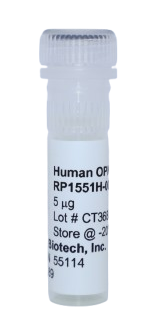
Human Osteopontin (OPN) Recombinant Protein
- Catalog Number:
- RP1551H
- Availability:
- In stock
- Application:
- Cell Culture, Control, ELISA, ELISpot Control, Western Blot Control
- 100% Homology:
- Homo sapiens (human)
 Powered by Bioz
 - Human OPN (Osteopontin) (catalog RP1551H) is a yeast-derived cytokine supplied lyophilized without carrier protein in 10% trehalose; it has no affinity tags and is naturally endotoxin-free, and should be reconstituted in sterile PBS that contains at least 0.1% carrier protein. The protein is ~33.7 kDa, 298 amino acids long (full sequence provided), and >98% pure by SDS-PAGE, with 100% amino-acid homology to human. Store at -20°C (stable up to twelve months from date of receipt; working aliquots with carrier protein stable ~3 months) and avoid repeated freeze/thaw cycles. Product origin is the USA. It is commonly used to study osteopontin signaling and cellular processes (including regulation of cell adhesion, migration, immune responses, inflammation, and bone remodeling); typical experimental uses include cell-culture stimulation and adhesion/migration assays, signaling studies, ELISA and neutralization assays, flow-cytometry and Western blot controls, and antibody generation/validation. Kingfisher Biotech products are supplied for research applications and are not intended for medicinal, diagnostic, or therapeutic use.
| Amino Acid Sequence | IPVKQADSGS SEEKQLYNKY PDAVATWLNP DPSQKQNLLA PQNAVSSEET NDFKQETLPS KSNESHDHMD DMDDEDDDDH VDSQDSIDSN DSDDVDDTDD SHQSDESHHS DESDELVTDF PTDLPATEVF TPVVPTVDTY DGRGDSVVYG LRSKSKKFRR PDIQYPDATD EDITSHMESE ELNGAYKAIP VAQDLNAPSD WDSRGKDSYE TSQLDDQSAE THSHKQSRLY KRKANDESNE HSDVIDSQEL SKVSREFHSH EFHSHEDMLV VDPKSKEEDK HLKFRISHEL DSASSEVN (298) |
| Endotoxin | Naturally endotoxin-free |
| Form | Lyophilized |
| Storage Conditions | -20°C |
| Molecular Weight | 33.7 kDa |
| Purity | >98% as visualized by SDS-PAGE analysis. |
| Expression System | Yeast |
| Form | Lyophilized |
| Country Of Origin | USA |
Human Osteopontin (OPN) (also known as SPP1, Secreted Phosphoprotein 1, bone sialoprotein I, ETA-1, or early T-lymphocyte activation-1) is a multifunctional phosphorylated glycoprotein involved in immune regulation, cell adhesion, and tissue remodeling. Osteopontin interacts with integrins (such as αvβ3, αvβ1, and α4β1) and CD44 receptors, activating signaling pathways that regulate cell migration, inflammatory responses, and extracellular matrix remodeling. In humans, OPN is produced by osteoblasts, macrophages, dendritic cells, epithelial cells, and activated T lymphocytes, and plays key roles in bone remodeling, immune activation, and tissue repair. OPN is also an important mediator of inflammatory and immune-mediated diseases, including rheumatoid arthritis, multiple sclerosis, inflammatory bowel disease, and atherosclerosis, where it contributes to leukocyte recruitment and cytokine signaling. In addition, osteopontin is strongly implicated in fibrosis and cancer, influencing tumor progression, angiogenesis, and immune cell infiltration in cancers such as breast, lung, and colorectal cancer. Because of its involvement in immune regulation, inflammation, and extracellular matrix remodeling, human osteopontin is widely studied as both a biomarker and therapeutic target in inflammatory diseases, fibrotic disorders, and oncology.
Citations
Please choose a size to see price
RELATED MEDIA
