Slide 1 of 1 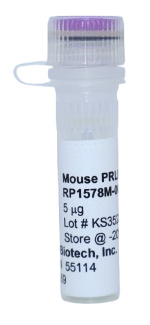
Mouse Prolactin Receptor Recombinant Protein
- Catalog Number:
- RP1578M
- Availability:
- In stock
- Application:
- Cell Culture, Control, ELISA, ELISpot Control, Western Blot Control
- 100% Homology:
- Mus musculus (house mouse)
 Powered by Bioz
 - Mouse Prolactin Receptor (PRLR) (catalog RP1578M) is a yeast-derived receptor protein supplied lyophilized without carrier protein in 10% trehalose; it has no affinity tags and is naturally endotoxin-free, and should be reconstituted in sterile PBS that contains at least 0.1% carrier protein. The protein is ~24.6 kDa, 210 amino acids long (full sequence provided), and >98% pure by SDS-PAGE, with 100% amino-acid homology to house mouse. Store at -20°C (stable up to twelve months from date of receipt; working aliquots with carrier protein stable ~3 months) and avoid repeated freeze/thaw cycles. Product origin is the USA. It is commonly used to study prolactin receptor signaling and endocrine biology (including regulation of prolactin-mediated pathways such as lactation, reproduction, and immune modulation); typical experimental uses include cell-culture stimulation and binding assays, receptor and signaling studies, ELISA and neutralization assays, flow-cytometry and Western blot controls, and antibody generation/validation. Kingfisher Biotech products are supplied for research applications and are not intended for medicinal, diagnostic, or therapeutic use.
| Amino Acid Sequence | QSPPGKPEIH KCRSPDKETF TCWWNPGSDG GLPTNYSLTY SKEGEKNTYE CPDYKTSGPN SCFFSKQYTS IWKIYIITVN ATNEMGSSTS DPLYVDVTYI VEPEPPRNLT LEVKQLKDKK TYLWVKWLPP TITDVKTGWF TMEYEIRLKS EEADEWEIHF TGHQTQFKVF DLYPGQKYLV QTRCKPDHGY WSRWGQEKSI EIPNDFTLKD (210) |
| Endotoxin | Naturally endotoxin-free |
| Form | Lyophilized |
| Storage Conditions | -20°C |
| Molecular Weight | 24.6 kDa |
| Purity | >98% as visualized by SDS-PAGE analysis. |
| Expression System | Yeast |
| Form | Lyophilized |
| Country Of Origin | USA |
Mouse Prolactin Receptor (PRLR) is a transmembrane receptor belonging to the class I cytokine receptor family, which also includes receptors for growth hormone (GHR), erythropoietin (EPOR), and several interleukins that signal through related intracellular pathways. In mice (Mus musculus), PRLR binds the hormone prolactin (PRL) and activates intracellular signaling cascades, primarily the JAK2/STAT5 pathway, along with MAPK and PI3K/AKT pathways, leading to regulation of genes involved in cell proliferation, differentiation, and metabolic function. Mouse PRLR is expressed in multiple tissues including the mammary gland, ovary, uterus, liver, adipose tissue, brain, and immune cells, where it mediates the diverse physiological effects of prolactin. PRLR signaling plays a critical role in mammary gland development, lactation, reproductive function, and maternal behavior. In addition to the membrane-bound receptor, soluble forms of mouse PRLR (sPRLR) can be generated through alternative splicing or proteolytic cleavage, producing extracellular receptor fragments capable of binding circulating prolactin and potentially modulating hormone availability and signaling activity. Because mice are widely used as genetic models, PRLR knockout and transgenic mouse models have been extensively utilized to study lactation biology, reproductive endocrinology, immune regulation, and prolactin signaling pathways, providing important insights into hormonal regulation and endocrine function relevant to human physiology and disease.
Citations
Please choose a size to see price
RELATED MEDIA
