Slide 1 of 1 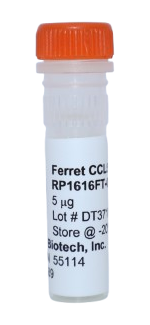
Multi-species (Ferret, Mink) CCL5 (RANTES) Recombinant Protein
- Catalog Number:
- RP1616FT
- Application:
- Cell Culture, Control, ELISA, ELISpot Control, Western Blot Control
- 100% Homology:
- Gulo gulo luscus (American wolverine), Meles meles (Eurasian badger), Mustela erminea (ermine), Mustela lutreola (European mink), Mustela nigripes (black-footed ferret), Mustela putorius furo (domestic ferret), Neogale vison (American mink)
 Powered by Bioz
 - Ferret/Mink CCL5 (RANTES, Regulated upon Activation, Normal T Cell Expressed and Secreted) (catalog RP1616FT) is a yeast-derived chemokine supplied lyophilized without carrier protein in 10% trehalose; it has no affinity tags and is naturally endotoxin-free, and should be reconstituted in sterile PBS that contains at least 0.1% carrier protein. The protein is ~8.0 kDa, 68 amino acids long (full sequence provided), and >98% pure by SDS-PAGE, with 100% amino-acid homology to domestic ferret, American mink, American wolverine, Eurasian badger, ermine, European mink, and black-footed ferret. Store at -20°C (stable up to twelve months from date of receipt; working aliquots with carrier protein stable ~3 months) and avoid repeated freeze/thaw cycles. Product origin is the USA. It is commonly used to study CCL5/RANTES signaling and immune-cell chemotaxis (including recruitment of T cells, eosinophils, and other leukocytes during inflammatory responses); typical experimental uses include cell-culture stimulation and migration assays, chemotaxis and signaling studies, ELISA and neutralization assays, flow-cytometry and Western blot controls, and antibody generation/validation. Kingfisher Biotech products are supplied for research applications and are not intended for medicinal, diagnostic, or therapeutic use.
| Amino Acid Sequence | SPYASDTTPC CFAYISRRLP FTHIQEYFYT SSKCSMPAVV FVTRKHRQVC ANPQKKWVRD HINSLEMS (68) |
| Endotoxin | Naturally endotoxin-free |
| Form | Lyophilized |
| Storage Conditions | -20°C |
| Molecular Weight | 8.0 kDa |
| Purity | >98% as visualized by SDS-PAGE analysis. |
| Affinity Tag | None |
| aminoAcids | 68 |
| Carrier Protein | None |
| Expression System | Yeast |
| Form | Lyophilized |
| Country Of Origin | USA |
Ferret CCL5 (C–C motif chemokine ligand 5, also known as RANTES – Regulated upon Activation, Normal T cell Expressed and Secreted) is a proinflammatory chemokine that regulates immune cell recruitment and inflammatory responses in ferrets (Mustela putorius furo). CCL5 is a member of the CC chemokine family, which also includes CCL3 (MIP-1α), CCL4 (MIP-1β), and CCL2 (MCP-1), chemokines that coordinate leukocyte trafficking during immune activation. In ferrets, CCL5 is produced primarily by activated T lymphocytes, macrophages, dendritic cells, platelets, and epithelial cells in response to viral infection, inflammatory stimuli, or tissue injury, and it exerts its biological effects mainly through binding to the chemokine receptors CCR1, CCR3, and CCR5, promoting chemotaxis and activation of T cells, monocytes/macrophages, eosinophils, and natural killer (NK) cells at sites of infection or inflammation. Ferrets are widely used as animal models for respiratory viral diseases, including influenza and SARS-related coronaviruses, and chemokines such as CCL5 play an important role in recruiting immune cells to the respiratory tract during viral infection, contributing to both antiviral defense and inflammatory pathology. Consequently, ferret CCL5 is frequently studied in infectious disease, immunology, and vaccine research, helping to elucidate mechanisms of chemokine-mediated immune responses and inflammatory regulation in respiratory disease models.
- Chemokine
Citations
Please choose a size to see price
RELATED MEDIA
