Slide 1 of 1 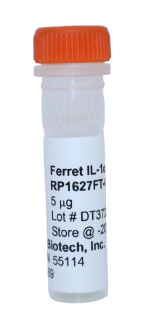
Ferret IL-1 alpha Recombinant Protein
- Catalog Number:
- RP1627FT
- Availability:
- In stock
- Application:
- Cell Culture, Control, ELISA, ELISpot Control, Western Blot Control
- 100% Homology:
- Mustela nigripes (black-footed ferret), Mustela putorius furo (domestic ferret)
 Powered by Bioz
 - Ferret IL-1α (Interleukin-1 alpha) (catalog RP1627FT) is a yeast-derived cytokine supplied lyophilized without carrier protein in 10% trehalose; it has no affinity tags and is naturally endotoxin-free, and should be reconstituted in sterile PBS that contains at least 0.1% carrier protein. The protein is ~17.8 kDa, 155 amino acids long (full sequence provided), and >98% pure by SDS-PAGE, with 100% amino-acid homology to domestic ferret and black-footed ferret. Store at -20°C (stable up to twelve months from date of receipt; working aliquots with carrier protein stable ~3 months) and avoid repeated freeze/thaw cycles. Product origin is the USA. It is commonly used to study IL-1α signaling and inflammatory responses (including regulation of immune activation, cytokine production, and inflammatory pathways); typical experimental uses include cell-culture stimulation and cytokine assays, signaling studies, ELISA and neutralization assays, flow-cytometry and Western blot controls, and antibody generation/validation. Kingfisher Biotech products are supplied for research applications and are not intended for medicinal, diagnostic, or therapeutic use.
| Amino Acid Sequence | SAAYNFRSNE KYNYMRIIKS QFILNDNLNQ SIIQQTGGNY LMAAALQNLD DAVKFDMGAY TSEDSKFPVT LRISKTRLFV SAQNEGEPVL LKEMPETPKT IKDETNLLFF WERHGTKNYF TSVAQPKLFI ATQERKLVHM AKGQPSITDF QILET (155) |
| Endotoxin | Naturally endotoxin-free |
| Form | Lyophilized |
| Storage Conditions | -20°C |
| Molecular Weight | 17.8 kDa |
| Purity | >98% as visualized by SDS-PAGE analysis. |
| Expression System | Yeast |
| Form | Lyophilized |
| Country Of Origin | USA |
Ferret Interleukin-1 Alpha (IL-1α) is a pro-inflammatory cytokine belonging to the IL-1 family—which includes IL-1α, IL-1β, and the IL-1 receptor antagonist (IL-1Ra)—and plays a key role in initiating early innate immune responses in ferrets (Mustela putorius furo). IL-1α is constitutively expressed in epithelial and barrier tissues and functions as an intracellular alarmin that is rapidly released upon cell injury, necrosis, or viral infection, triggering immediate inflammatory signaling. Upon binding to the IL-1 receptor type 1 (IL-1R1), IL-1α activates NF-κB and MAPK pathways that promote leukocyte recruitment, vascular activation, fever, and amplification of downstream cytokine cascades. In ferret health and research, IL-1α is particularly relevant in respiratory viral infection models such as influenza virus and SARS-CoV-2, where epithelial cell damage leads to IL-1α release and contributes to early lung inflammation and immune cell infiltration. While critical for initiating antiviral defense, excessive IL-1α signaling may exacerbate pulmonary pathology and cytokine-mediated tissue injury. As an early mediator of sterile and infectious inflammation, ferret IL-1α serves as a biomarker of epithelial damage and innate immune activation. Given the ferret’s widespread use as a translational model for human respiratory disease and viral transmission studies, characterization of IL-1α supports investigations into cytokine-driven lung inflammation, host–pathogen interactions, and development of targeted anti-inflammatory or immunomodulatory therapies relevant to human respiratory immunology.
Citations
Please choose a size to see price
RELATED MEDIA
