Slide 1 of 1 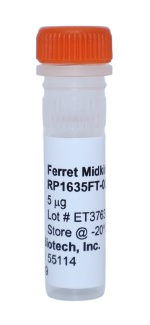
Multi-species (Ferret, Mink) Midkine Recombinant Protein
- Catalog Number:
- RP1635FT
- Availability:
- In stock
- Application:
- Cell Culture, Control, ELISA, ELISpot Control, Western Blot Control
- 100% Homology:
- Enhydra lutris kenyoni (sea otter), Mustela erminea (ermine), Mustela lutreola (European mink), Mustela nigripes (black-footed ferret), Mustela putorius furo (domestic ferret), Neogale vison (American mink)
 Powered by Bioz
 - Ferret/Mink Midkine (MK) (catalog RP1635FT) is a yeast-derived growth factor supplied lyophilized without carrier protein in 10% trehalose; it has no affinity tags and is naturally endotoxin-free, and should be reconstituted in sterile PBS that contains at least 0.1% carrier protein. The protein is ~13.2 kDa, 121 amino acids long (full sequence provided), and >98% pure by SDS-PAGE, with 100% amino-acid homology to domestic ferret, American mink, sea otter, ermine, European mink, and black-footed ferret. Store at -20°C (stable up to twelve months from date of receipt; working aliquots with carrier protein stable ~3 months) and avoid repeated freeze/thaw cycles. Product origin is the USA. It is commonly used to study midkine signaling and cellular processes (including regulation of cell growth, survival, migration, and development); typical experimental uses include cell-culture stimulation and proliferation assays, signaling studies, ELISA and neutralization assays, flow-cytometry and Western blot controls, and antibody generation/validation. Kingfisher Biotech products are supplied for research applications and are not intended for medicinal, diagnostic, or therapeutic use.
| Amino Acid Sequence | KKKDKVKKGG PGTECAEWAW GPCTPSSKDC GVGFREGTCG AQTQRTRCRV PCNWKKEFGA DCKYKFESWG ACDGGTGTKA RQGTLKKARY NAQCQETIRV TKPCTPKTKA KAKAKKGKGK D (121) |
| Endotoxin | Naturally endotoxin-free |
| Form | Lyophilized |
| Storage Conditions | -20°C |
| Molecular Weight | 13.2 kDa |
| Purity | >98% as visualized by SDS-PAGE analysis. |
| Expression System | Yeast |
| Form | Lyophilized |
| Country Of Origin | USA |
Ferret/Mink Midkine (MK) is a heparin-binding growth factor and cytokine that plays important roles in cell growth, survival, and tissue repair in ferrets (Mustela putorius furo) and mink (Neogale vison). The midkine protein is identical at the amino acid level in these two species, reflecting strong evolutionary conservation of this growth factor within mustelids. Midkine is highly expressed during embryonic development and can also be induced in adult tissues in response to injury, inflammation, or physiological stress. Ferret and mink midkine interact with several cell surface receptors, including receptor-type protein tyrosine phosphatase ζ (PTPRZ1), low-density lipoprotein receptor–related proteins (LRPs), and integrins, activating intracellular signaling pathways such as MAPK, PI3K–AKT, and NF-κB that regulate cell proliferation, migration, and survival. Through these mechanisms, midkine contributes to processes including tissue regeneration, angiogenesis, immune cell recruitment, and inflammatory regulation. In cell culture, recombinant ferret/mink midkine is commonly used to stimulate cell proliferation and migration and to study growth factor–mediated signaling pathways involved in tissue repair and inflammatory responses. Ferrets and mink are also used in infectious disease research models, making midkine relevant for studies investigating tissue injury, immune regulation, and host responses during viral infection.
Citations
Please choose a size to see price
RELATED MEDIA
