Slide 1 of 1 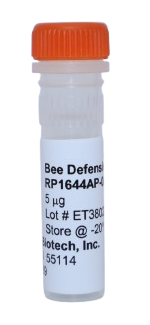
Bee Defensin-1 Recombinant Protein
- Catalog Number:
- RP1644AP
- Availability:
- In stock
- Application:
- Cell Culture, Control, ELISA, ELISpot Control, Western Blot Control
- 100% Homology:
- Apis mellifera (honey bee)
 Powered by Bioz
 - Bee Defensin-1 (catalog RP1644AP) is a yeast-derived antimicrobial peptide supplied lyophilized without carrier protein in 10% trehalose; it has no affinity tags and is naturally endotoxin-free, and should be reconstituted in sterile PBS that contains at least 0.1% carrier protein. The protein is ~5.6 kDa, 52 amino acids long (full sequence provided), and >98% pure by SDS-PAGE, with 100% amino-acid homology to honey bee. Store at -20°C (stable up to twelve months from date of receipt; working aliquots with carrier protein stable ~3 months) and avoid repeated freeze/thaw cycles. Product origin is the USA. It is commonly used to study antimicrobial peptide activity and innate immune responses (including antibacterial defense mechanisms and host-pathogen interactions); typical experimental uses include antimicrobial and inhibition assays, cell-culture studies, immune signaling studies, and assay controls for ELISA, flow-cytometry, and Western blot applications. Kingfisher Biotech products are supplied for research applications and are not intended for medicinal, diagnostic, or therapeutic use.
| Amino Acid Sequence | VTCDLLSFKG QVNDSACAAN CLSLGKAGGH CEKGVCICRK TSFKDLWDKR FG (52) |
| Endotoxin | Naturally endotoxin-free |
| Form | Lyophilized |
| Storage Conditions | -20°C |
| Molecular Weight | 5.6 kDa |
| Purity | >98% as visualized by SDS-PAGE analysis. |
| Expression System | Yeast |
| Form | Lyophilized |
| Country Of Origin | USA |
Human Defensin β1 (DEFB1), also known as Human Beta-Defensin 1 (hBD-1), is an antimicrobial peptide belonging to the β-defensin family, which also includes DEFB4 (hBD-2) and DEFB103 (hBD-3) that contribute to innate immune defense at epithelial surfaces. In humans (Homo sapiens), DEFB1 is constitutively expressed by epithelial cells in tissues such as the skin, respiratory tract, gastrointestinal tract, and urogenital tract, where it functions as a first-line defense against microbial pathogens. Structurally, DEFB1 is a cationic, cysteine-rich peptide stabilized by disulfide bonds, enabling it to interact with and disrupt microbial membranes, particularly those of bacteria, fungi, and some viruses. In addition to its direct antimicrobial activity, human β-defensin 1 can help regulate immune signaling and leukocyte recruitment, contributing to the maintenance of mucosal immunity and barrier integrity. Dysregulation of DEFB1 expression has been associated with susceptibility to infections, inflammatory diseases, and cancer, particularly in epithelial tissues. Because defensins play key roles in host–microbe interactions and epithelial immune defense, human DEFB1 is widely studied in immunology, infectious disease research, and mucosal biology as an important component of the innate immune system.
Citations
Please choose a size to see price
RELATED MEDIA
