Slide 1 of 1 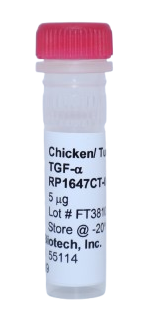
Multi-species (Chicken, Turkey) TGF-alpha Recombinant Protein
- Catalog Number:
- RP1647CT
- Availability:
- In stock
- Application:
- Cell Culture, Control, ELISA, ELISpot Control, Western Blot Control
- 100% Homology:
- Coturnix japonica (Japanese quail), Gallus gallus (chicken), Meleagris gallopavo (turkey), Numida meleagris (helmeted guineafowl)
 Powered by Bioz
 - Chicken/Turkey TGF-α (Transforming Growth Factor alpha) (catalog RP1647CT) is a yeast-derived growth factor supplied lyophilized without carrier protein in 10% trehalose; it has no affinity tags and is naturally endotoxin-free, and should be reconstituted in sterile PBS that contains at least 0.1% carrier protein. The protein is ~5.7 kDa, 50 amino acids long (full sequence provided), and >98% pure by SDS-PAGE, with 100% amino-acid homology to chicken, turkey, Japanese quail, and helmeted guineafowl. Store at -20°C (stable up to twelve months from date of receipt; working aliquots with carrier protein stable ~3 months) and avoid repeated freeze/thaw cycles. Product origin is the USA. It is commonly used to study TGF-α/EGFR signaling and cellular processes (including regulation of cell proliferation, differentiation, and tissue development); typical experimental uses include cell-culture stimulation and growth assays, signaling studies, ELISA and neutralization assays, flow-cytometry and Western blot controls, and antibody generation/validation. Kingfisher Biotech products are supplied for research applications and are not intended for medicinal, diagnostic, or therapeutic use.
| Amino Acid Sequence | VVSHFNKCPD SHTQYCFHGT CRFLVQEEKP ACVCHSGYVG VRCEHADLLA (50) |
| Endotoxin | Naturally endotoxin-free |
| Form | Lyophilized |
| Storage Conditions | -20°C |
| Molecular Weight | 5.7 kDa |
| Purity | >98% as visualized by SDS-PAGE analysis. |
| Expression System | Yeast |
| Form | Lyophilized |
| Country Of Origin | USA |
Chicken and Turkey Transforming Growth Factor Alpha (TGF-α) is a member of the epidermal growth factor (EGF) family of growth factors, which also includes epidermal growth factor (EGF), amphiregulin, betacellulin, epiregulin, and heparin-binding EGF-like growth factor (HB-EGF). In both chickens (Gallus gallus) and turkeys (Meleagris gallopavo), the TGF-α protein is identical at the amino acid level, indicating strong evolutionary conservation and suggesting similar biological functions in these avian species. TGF-α is initially synthesized as a membrane-anchored precursor that is proteolytically cleaved to release a soluble ligand that binds the epidermal growth factor receptor (EGFR/ErbB1). Activation of EGFR stimulates intracellular signaling pathways including MAPK/ERK, PI3K/AKT, and JAK/STAT, which regulate cell proliferation, differentiation, and tissue growth. In chickens and turkeys, TGF-α is expressed in tissues such as the skin, gastrointestinal tract, and developing epithelial tissues, where it contributes to epithelial development, tissue repair, and regulation of cell growth. TGF-α signaling is also involved in avian embryonic development and epithelial tissue regeneration following injury. Because poultry species are widely used in developmental biology, epithelial biology, and agricultural research, characterization of chicken and turkey TGF-α supports studies of EGFR signaling, tissue growth regulation, and conserved growth factor functions in vertebrate development relevant to poultry health and production.
Citations
Please choose a size to see price
RELATED MEDIA
