Slide 1 of 1 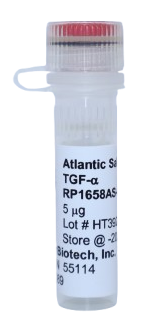
Atlantic Salmon TGF-alpha Recombinant Protein
- Catalog Number:
- RP1658AS
- Availability:
- In stock
- Application:
- Cell Culture, Control, ELISA, ELISpot Control, Western Blot Control
- 100% Homology:
- Oncorhynchus mykiss (rainbow trout), Oncorhynchus nerka (sockeye salmon), Salmo salar (Atlantic salmon), Salmo trutta (river trout), Salvelinus alpinus (Arctic char), Sphaeramia orbicularis (orbiculate cardinalfish)
 Powered by Bioz
 - Atlantic Salmon TGF-α (Transforming Growth Factor alpha) (catalog RP1658AS) is a yeast-derived growth factor supplied lyophilized without carrier protein in 10% trehalose; it has no affinity tags and is naturally endotoxin-free, and should be reconstituted in sterile PBS that contains at least 0.1% carrier protein. The protein is ~5.7 kDa, 50 amino acids long (full sequence provided), and >98% pure by SDS-PAGE, with 100% amino-acid homology to Atlantic salmon, rainbow trout, sockeye salmon, river trout, Arctic char, and orbiculate cardinalfish. Store at -20°C (stable up to twelve months from date of receipt; working aliquots with carrier protein stable ~3 months) and avoid repeated freeze/thaw cycles. Product origin is the USA. It is commonly used to study TGF-α/EGFR signaling and cellular processes (including regulation of cell proliferation, differentiation, and tissue development); typical experimental uses include cell-culture stimulation and growth assays, signaling studies, ELISA and neutralization assays, flow-cytometry and Western blot controls, and antibody generation/validation. Kingfisher Biotech products are supplied for research applications and are not intended for medicinal, diagnostic, or therapeutic use.
| Amino Acid Sequence | VRSHFDDCPD SHSHFCFHGT CRFLILEETP ACVCHQGFVG MRCEHADLLA (50) |
| Endotoxin | Naturally endotoxin-free |
| Form | Lyophilized |
| Storage Conditions | -20°C |
| Molecular Weight | 5.7 kDa |
| Purity | >98% as visualized by SDS-PAGE analysis. |
| Expression System | Yeast |
| Form | Lyophilized |
| Country Of Origin | USA |
Atlantic Salmon (Salmo salar) Transforming Growth Factor Alpha (TGF-α) is a member of the epidermal growth factor (EGF) family of growth factors, which also includes epidermal growth factor (EGF), amphiregulin, betacellulin, epiregulin, and heparin-binding EGF-like growth factor (HB-EGF). In Atlantic salmon, TGF-α is synthesized as a membrane-bound precursor (pro–TGF-α) that is proteolytically cleaved to release a soluble ligand capable of binding the epidermal growth factor receptor (EGFR). Activation of EGFR stimulates intracellular signaling pathways such as MAPK/ERK, PI3K/AKT, and JAK/STAT, which regulate cell proliferation, differentiation, epithelial growth, and tissue regeneration. In salmon, TGF-α is expressed in tissues including the skin, gills, gastrointestinal tract, and developing organs, where it contributes to epithelial maintenance, mucosal barrier function, and tissue repair following injury or infection. Because epithelial surfaces such as the skin and gills are critical interfaces with the aquatic environment, TGF-α–mediated signaling plays an important role in barrier integrity and regeneration of damaged tissues. Characterization of Atlantic salmon TGF-α supports research on fish epithelial biology, wound healing, developmental processes, and host responses to environmental stress or pathogens, contributing to improved understanding of tissue regeneration and health in aquaculture species.
Citations
Please choose a size to see price
RELATED MEDIA
