Slide 1 of 1 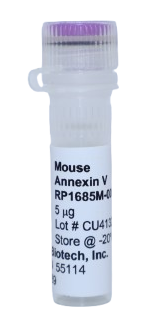
Mouse Annexin V Recombinant Protein
- Catalog Number:
- RP1685M
- Availability:
- In stock
- Application:
- Cell Culture, Control, ELISA, ELISpot Control, Western Blot Control
- 100% Homology:
- Mus musculus (house mouse)
 Powered by Bioz
 - Mouse Annexin V (ANXV) (catalog RP1685M) is a yeast-derived protein supplied lyophilized without carrier protein in 10% trehalose; it has no affinity tags and is naturally endotoxin-free, and should be reconstituted in sterile PBS that contains at least 0.1% carrier protein. The protein is ~35.8 kDa, 319 amino acids long (full sequence provided), and >98% pure by SDS-PAGE, with 100% amino-acid homology to house mouse. Store at -20°C (stable up to twelve months from date of receipt; working aliquots with carrier protein stable ~3 months) and avoid repeated freeze/thaw cycles. Product origin is the USA. It is commonly used to study Annexin V function and cellular processes (including phosphatidylserine binding, apoptosis detection, and membrane-related events); typical experimental uses include apoptosis assays, cell-culture studies, binding assays, flow-cytometry and fluorescence-based assays, and Western blot controls. Kingfisher Biotech products are supplied for research applications and are not intended for medicinal, diagnostic, or therapeutic use.
| Amino Acid Sequence | MATRGTVTDF PGFDGRADAE VLRKAMKGLG TDEDSILNLL TSRSNAQRQE IAQEFKTLFG RDLVDDLKSE LTGKFEKLIV AMMKPSRLYD AYELKHALKG AGTDEKVLTE IIASRTPEEL SAIKQVYEEE YGSNLEDDVV GDTSGYYQRM LVVLLQANRD PDTAIDDAQV ELDAQALFQA GELKWGTDEE KFITIFGTRS VSHLRRVFDK YMTISGFQIE ETIDRETSGN LEQLLLAVVK SIRSIPAYLA ETLYYAMKGA GTDDHTLIRV VVSRSEIDLF NIRKEFRKNF ATSLYSMIKG DTSGDYKKAL LLLCGGEDD (319) |
| Endotoxin | Naturally endotoxin-free |
| Form | Lyophilized |
| Storage Conditions | -20°C |
| Molecular Weight | 35.8 kDa |
| Purity | >98% as visualized by SDS-PAGE analysis. |
| Expression System | Yeast |
| Form | Lyophilized |
| Country Of Origin | USA |
Mouse Annexin V (also known as ANXA5, Annexin A5, placental anticoagulant protein I (PAP-I), lipocortin V, or anchorin CII) is a calcium-dependent phospholipid-binding protein belonging to the annexin family, which plays important roles in membrane organization, cellular signaling, inflammation, and regulation of apoptosis. In mice (Mus musculus), Annexin V binds with high affinity to phosphatidylserine exposed on the outer leaflet of the plasma membrane during early stages of apoptosis or cellular damage in the presence of calcium ions. Because of this property, FITC-labeled mouse Annexin V (Annexin V–FITC) is widely used in flow cytometry and fluorescence microscopy assays to detect and quantify apoptotic cells. Conjugation with fluorescein isothiocyanate (FITC) enables fluorescent labeling of cells exposing phosphatidylserine, allowing sensitive identification of early apoptotic cells, typically in combination with viability dyes such as propidium iodide (PI) or 7-AAD to distinguish early apoptosis from late apoptosis or necrosis. In mouse research, Annexin V–FITC assays are extensively used in studies of immune cell apoptosis, cancer biology, drug-induced cytotoxicity, neurodegeneration, and inflammatory diseases. Because mice are the most widely used genetic model organism in biomedical research, Annexin V–FITC staining is a standard tool for investigating cell death pathways, evaluating therapeutic responses, and studying host–pathogen interactions. As a biomarker of apoptosis and membrane remodeling, mouse Annexin V plays a critical role in experimental studies of cell survival, immune regulation, and disease pathogenesis.
Citations
Please choose a size to see price
RELATED MEDIA
