Slide 1 of 1 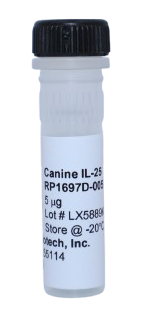
Canine IL-25 (IL-17E) Recombinant Protein
- Catalog Number:
- RP1697D
- Availability:
- In stock
- Application:
- Cell Culture, Control, ELISA, ELISpot Control, Western Blot Control
- 100% Homology:
- Canis lupus dingo (dingo), Canis lupus familiaris (dog)
 Powered by Bioz
 - Canine IL-25 (IL-17E) (catalog RP1697D) is a yeast-derived cytokine supplied lyophilized without carrier protein in 10% trehalose; it has no affinity tags and is naturally endotoxin-free, and should be reconstituted in sterile PBS that contains at least 0.1% carrier protein. The protein is ~17.7 kDa, 153 amino acids long (full sequence provided), and >98% pure by SDS-PAGE, with 100% amino-acid homology to dog and dingo. Store at -20°C (stable up to twelve months from date of receipt; working aliquots with carrier protein stable ~3 months) and avoid repeated freeze/thaw cycles. Product origin is the USA. It is commonly used to study IL-25/IL-17E signaling and immune responses (including regulation of type 2 immunity, inflammation, and cytokine production); typical experimental uses include cell-culture stimulation and cytokine assays, signaling studies, ELISA and neutralization assays, flow-cytometry and Western blot controls, and antibody generation/validation. Kingfisher Biotech products are supplied for research applications and are not intended for medicinal, diagnostic, or therapeutic use.
| Amino Acid Sequence | LNFRIRKDCT HWPNCCPSKR QDPTHEWLKR DTVLKFPGET TSLTHHPESC KASEDGPLNS RSISPWKYEL DRDLNRLPQD LYHARCLCQH CVSLQTGSHM DPLGNSELLY HNQTVFYRRP CPGEQGAPDG YCLEQRLYRV SLACVCVRPR VMA (153) |
| Endotoxin | Naturally endotoxin-free |
| Form | Lyophilized |
| Storage Conditions | -20°C |
| Molecular Weight | 17.7 kDa |
| Purity | >98% as visualized by SDS-PAGE analysis. |
| Expression System | Yeast |
| Form | Lyophilized |
| Country Of Origin | USA |
Canine interleukin-25 (IL-25), also known as IL-17E, is a member of the IL-17 cytokine family and functions as a key promoter of type 2 immune responses through signaling via the IL-17RA/IL-17RB receptor complex, activating downstream NF-κB and MAPK pathways. In dogs, IL-25 is expected to drive Th2-associated cytokine production—including IL-4, IL-5, and IL-13—leading to eosinophil recruitment, IgE-associated responses, and enhanced mucosal immunity. In canine health, cIL-25 is particularly relevant in allergic and inflammatory diseases characterized by type 2 immune polarization, such as canine atopic dermatitis, allergic otitis, food hypersensitivity, eosinophilic gastrointestinal disease, and canine asthma–like airway inflammation. While IL-25 supports protective immunity against parasitic infections, dysregulated signaling may contribute to chronic pruritus, skin barrier dysfunction, airway hyperreactivity, and gastrointestinal inflammation. Because dogs naturally develop spontaneous allergic and inflammatory disorders within an intact immune system, canine IL-25 represents both a potential biomarker and therapeutic target in veterinary medicine, as well as a valuable comparative model for studying type 2–driven diseases analogous to human asthma, atopic dermatitis, and allergic gastrointestinal disorders.
Citations
Please choose a size to see price
RELATED MEDIA
