Slide 1 of 1 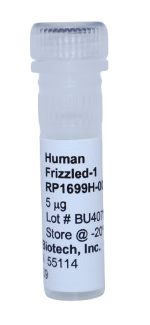
Human Frizzled-1 Recombinant Protein
- Catalog Number:
- RP1699H
- Availability:
- In stock
- Application:
- Cell Culture, Control, ELISA, ELISpot Control, Western Blot Control
- 100% Homology:
- Homo sapiens (human)
 Powered by Bioz
 - Human Frizzled-1 (FZD1) (catalog RP1699H) is a yeast-derived receptor protein supplied lyophilized without carrier protein in 10% trehalose; it has no affinity tags and is naturally endotoxin-free, and should be reconstituted in sterile PBS that contains at least 0.1% carrier protein. The protein is ~19.4 kDa, 178 amino acids long (full sequence provided), and >98% pure by SDS-PAGE, with 100% amino-acid homology to human. Store at -20°C (stable up to twelve months from date of receipt; working aliquots with carrier protein stable ~3 months) and avoid repeated freeze/thaw cycles. Product origin is the USA. It is commonly used to study Frizzled-1/Wnt signaling and cellular processes (including regulation of cell proliferation, differentiation, and developmental pathways); typical experimental uses include cell-culture stimulation and receptor-binding assays, signaling studies, ELISA and neutralization assays, flow-cytometry and Western blot controls, and antibody generation/validation. Kingfisher Biotech products are supplied for research applications and are not intended for medicinal, diagnostic, or therapeutic use.
| Amino Acid Sequence | QAAGQGPGQG PGPGQQPPPP PQQQQSGQQY NGERGISVPD HGYCQPISIP LCTDIAYNQT IMPNLLGHTN QEDAGLEVHQ FYPLVKVQCS AELKFFLCSM YAPVCTVLEQ ALPPCRSLCE RARQGCEALM NKFGFQWPDT LKCEKFPVHG AGELCVGQNT SDKGTPTPSL LPEFWTSN (178) |
| Endotoxin | Naturally endotoxin-free |
| Form | Lyophilized |
| Storage Conditions | -20°C |
| Molecular Weight | 19.4 kDa |
| Purity | >98% as visualized by SDS-PAGE analysis. |
| Expression System | Yeast |
| Form | Lyophilized |
| Country Of Origin | USA |
Human Frizzled-1 (FZD1) is a seven-transmembrane receptor protein belonging to the Frizzled family of Wnt receptors, which includes FZD1–FZD10 that mediate signaling in the Wnt signaling pathway. In humans (Homo sapiens), FZD1 is expressed in a variety of tissues including bone, brain, and other epithelial and connective tissues, where it functions as a cell-surface receptor for Wnt ligands. Upon binding of Wnt proteins, FZD1 interacts with co-receptors such as LRP5/6 to activate downstream signaling pathways, most notably the canonical Wnt/β-catenin pathway, as well as non-canonical Wnt signaling pathways. These signaling cascades regulate cell proliferation, differentiation, migration, and tissue development. In human physiology, FZD1 plays an important role in bone formation and osteoblast differentiation, contributing to the regulation of skeletal development and bone remodeling. Dysregulation of Wnt–FZD1 signaling has been associated with cancer, bone disorders, and developmental abnormalities, as aberrant activation of Wnt signaling can lead to uncontrolled cell growth and altered tissue homeostasis. Consequently, human FZD1 is widely studied in developmental biology, cancer research, and regenerative medicine as a key component of the Wnt signaling network controlling cell fate and tissue maintenance.
Citations
Please choose a size to see price
RELATED MEDIA
