Slide 1 of 1 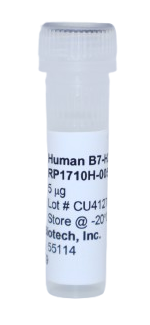
Human B7-H2 Recombinant Protein
- Catalog Number:
- RP1710H
- Availability:
- In stock
- Application:
- Cell Culture, Control, ELISA, ELISpot Control, Western Blot Control
- 100% Homology:
- Homo sapiens (human)
 Powered by Bioz
 - Human B7-H2 (ICOS Ligand, CD275) (catalog RP1710H) is a yeast-derived immune checkpoint protein supplied lyophilized without carrier protein in 10% trehalose; it has no affinity tags and is naturally endotoxin-free, and should be reconstituted in sterile PBS that contains at least 0.1% carrier protein. The protein is ~26.4 kDa, 238 amino acids long (full sequence provided), and >98% pure by SDS-PAGE, with 100% amino-acid homology to human. Store at -20°C (stable up to twelve months from date of receipt; working aliquots with carrier protein stable ~3 months) and avoid repeated freeze/thaw cycles. Product origin is the USA. It is commonly used to study B7-H2/ICOS signaling and immune responses (including regulation of T-cell activation, co-stimulation, and immune modulation); typical experimental uses include cell-culture stimulation and binding assays, immune checkpoint and signaling studies, ELISA and neutralization assays, flow-cytometry and Western blot controls, and antibody generation/validation. Kingfisher Biotech products are supplied for research applications and are not intended for medicinal, diagnostic, or therapeutic use.
| Amino Acid Sequence | DTQEKEVRAM VGSDVELSCA CPEGSRFDLN DVYVYWQTSE SKTVVTYHIP QNSSLENVDS RYRNRALMSP AGMLRGDFSL RLFNVTPQDE QKFHCLVLSQ SLGFQEVLSV EVTLHVAANF SVPVVSAPHS PSQDELTFTC TSINGYPRPN VYWINKTDNS LLDQALQNDT VFLNMRGLYD VVSVLRIART PSVNIGCCIE NVLLQQNLTV GSQTGNDIGE RDKITENPVS TGEKNAAT (238) |
| Endotoxin | Naturally endotoxin-free |
| Form | Lyophilized |
| Storage Conditions | -20°C |
| Molecular Weight | 26.4 kDa |
| Purity | >98% as visualized by SDS-PAGE analysis. |
| Expression System | Yeast |
| Form | Lyophilized |
| Country Of Origin | USA |
Human B7-H2, also known as ICOS ligand (ICOSL) or CD275, is a member of the B7 family of costimulatory molecules that plays a central role in regulating adaptive immune responses. It is expressed primarily on antigen-presenting cells—including dendritic cells, B cells, monocytes, and macrophages—as well as on certain endothelial and epithelial cells, particularly following inflammatory stimulation. B7-H2 binds to its receptor ICOS (Inducible T cell Co-Stimulator) on activated T cells, delivering a critical costimulatory signal that promotes T cell proliferation, survival, cytokine production (including IL-4, IL-10, and IL-21), and differentiation. The B7-H2–ICOS pathway is especially important for T follicular helper (Tfh) cell development, germinal center formation, immunoglobulin class switching, and long-lived plasma cell responses, making it essential for effective humoral immunity. Dysregulation of B7-H2 signaling has been implicated in autoimmune diseases such as systemic lupus erythematosus (SLE), rheumatoid arthritis, and inflammatory bowel disease, as well as in allergic disorders, chronic infections, and tumor immune evasion. In clinical and translational research, human B7-H2 is studied as a key regulator of T cell–B cell interactions and as a potential therapeutic target in immuno-oncology, autoimmunity, and vaccine development.
Citations
Please choose a size to see price
RELATED MEDIA
