Slide 1 of 1 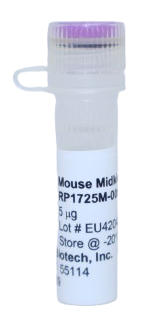
Mouse Midkine Recombinant Protein
- Catalog Number:
- RP1725M
- Availability:
- In stock
- Application:
- Cell Culture, Control, ELISA, ELISpot Control, Western Blot Control
- 100% Homology:
- Mastomys coucha (southern multimammate mouse), Mus caroli (Ryukyu mouse), Mus musculus (house mouse), Mus pahari (shrew mouse)
 Powered by Bioz
 - Mouse Midkine (MK) (catalog RP1725M) is a yeast-derived growth factor supplied lyophilized without carrier protein in 10% trehalose; it has no affinity tags and is naturally endotoxin-free, and should be reconstituted in sterile PBS that contains at least 0.1% carrier protein. The protein is ~13.1 kDa, 118 amino acids long (full sequence provided), and >98% pure by SDS-PAGE, with 100% amino-acid homology to house mouse, southern multimammate mouse, shrew mouse, and Ryukyu mouse. Store at -20°C (stable up to twelve months from date of receipt; working aliquots with carrier protein stable ~3 months) and avoid repeated freeze/thaw cycles. Product origin is the USA. It is commonly used to study midkine signaling and cellular processes (including regulation of cell growth, survival, migration, and development); typical experimental uses include cell-culture stimulation and proliferation assays, signaling studies, ELISA and neutralization assays, flow-cytometry and Western blot controls, and antibody generation/validation. Kingfisher Biotech products are supplied for research applications and are not intended for medicinal, diagnostic, or therapeutic use.
| Amino Acid Sequence | KKKEKVKKGS ECSEWTWGPC TPSSKDCGMG FREGTCGAQT QRVHCKVPCN WKKEFGADCK YKFESWGACD GSTGTKARQG TLKKARYNAQ CQETIRVTKP CTSKTKSKTK AKKGKGKD (118) |
| Endotoxin | Naturally endotoxin-free |
| Form | Lyophilized |
| Storage Conditions | -20°C |
| Molecular Weight | 13.1 kDa |
| Purity | >98% as visualized by SDS-PAGE analysis. |
| Expression System | Yeast |
| Form | Lyophilized |
| Country Of Origin | USA |
Mouse Midkine (MK) is a heparin-binding growth factor and cytokine that plays important roles in cell growth, development, and tissue repair in mice (Mus musculus). Midkine is highly expressed during embryonic development and can also be induced in adult tissues in response to injury, inflammation, or physiological stress. Mouse midkine interacts with several cell surface receptors, including receptor-type protein tyrosine phosphatase ζ (PTPRZ1), low-density lipoprotein receptor–related proteins (LRPs), and integrins, activating intracellular signaling pathways such as MAPK, PI3K–AKT, and NF-κB that regulate cell proliferation, migration, survival, and inflammatory responses. Through these mechanisms, midkine contributes to processes including neural development, angiogenesis, immune cell recruitment, and tissue regeneration. In cell culture, recombinant mouse midkine is commonly used to stimulate cell proliferation and migration and to study growth factor–mediated signaling pathways involved in development, inflammation, and tissue repair. Mouse midkine is also widely studied in murine animal models of cancer, inflammatory diseases, and tissue injury to better understand its roles in immune regulation, tumor progression, and regenerative processes.
Citations
Please choose a size to see price
RELATED MEDIA
