Slide 1 of 1 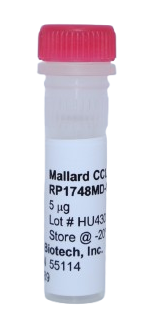
Duck CCL19 (MIP-3 beta)Recombinant Protein
- Catalog Number:
- RP1748MD
- Availability:
- In stock
- Application:
- Cell Culture, Control, ELISA, ELISpot Control, Western Blot Control
- 100% Homology:
- Anas platyrhynchos (mallard)
 Powered by Bioz
 - Mallard CCL19 (MIP-3β, Macrophage Inflammatory Protein-3 beta) (catalog RP1748MD) is a yeast-derived chemokine supplied lyophilized without carrier protein in 10% trehalose; it has no affinity tags and is naturally endotoxin-free, and should be reconstituted in sterile PBS that contains at least 0.1% carrier protein. The protein is ~8.6 kDa, 77 amino acids long (full sequence provided), and >98% pure by SDS-PAGE, with 100% amino-acid homology to mallard. Store at -20°C (stable up to twelve months from date of receipt; working aliquots with carrier protein stable ~3 months) and avoid repeated freeze/thaw cycles. Product origin is the USA. It is commonly used to study CCL19/MIP-3β signaling and immune-cell trafficking (including regulation of lymphocyte migration and homing to lymphoid tissues); typical experimental uses include cell-culture stimulation and migration assays, chemotaxis and signaling studies, ELISA and neutralization assays, flow-cytometry and Western blot controls, and antibody generation/validation. Kingfisher Biotech products are supplied for research applications and are not Mallard IL-17F (Interleukin-17F) (catalog RP1749MD) is a yeast-derived cytokine supplied lyophilized without carrier protein in 10% trehalose; it has no affinity tags and is naturally endotoxin-free, and should be reconstituted in sterile PBS that contains at least 0.1% carrier protein. The protein is ~15.9 kDa, 141 amino acids long (full sequence provided), and >98% pure by SDS-PAGE, with 100% amino-acid homology to mallard. Store at -20°C (stable up to twelve months from date of receipt; working aliquots with carrier protein stable ~3 months) and avoid repeated freeze/thaw cycles. Product origin is the USA. It is commonly used to study IL-17F signaling and immune responses (including regulation of inflammatory pathways, host defense, and cytokine-mediated immune responses); typical experimental uses include cell-culture stimulation and cytokine assays, signaling studies, ELISA and neutralization assays, flow-cytometry and Western blot controls, and antibody generation/validation. Kingfisher Biotech products are supplied for research applications and are not intended for medicinal, diagnostic, or therapeutic use.
| Amino Acid Sequence | GNNVLDCCLR TSENPIPRRI VQRYQIQLVQ DGCEIPANVF ITVRGKRLCA PLEAPWAVRL REKLDSGSAR KVPNKGN (77) |
| Endotoxin | Naturally endotoxin-free |
| Form | Lyophilized |
| Storage Conditions | -20°C |
| Molecular Weight | 8.6 kDa |
| Purity | >98% as visualized by SDS-PAGE analysis. |
| Expression System | Yeast |
| Form | Lyophilized |
| Country Of Origin | USA |
Mallard CCL19 (C-C motif chemokine ligand 19), also referred to as macrophage inflammatory protein-3β (MIP-3β) or EBI1 ligand chemokine (ELC)-like in avian species, is a member of the CC chemokine family that regulates lymphocyte trafficking and organization of secondary lymphoid tissues in mallards (Anas platyrhynchos). CCL19 is expressed primarily by stromal cells, dendritic cells, and macrophages within lymphoid organs such as the spleen, thymus, and gut-associated lymphoid tissues. It functions through a CCR7-like receptor to direct migration of naïve T cells and mature dendritic cells to lymphoid tissues, facilitating antigen presentation and initiation of adaptive immune responses. In healthy mallards, CCL19 contributes to immune surveillance and maintenance of lymphoid architecture; expression may increase during viral or bacterial infection, vaccination, or inflammatory stimulation. In avian and wildlife immunology research, mallard CCL19 is particularly relevant in studies of host responses to avian influenza virus and other waterfowl-associated pathogens, as mallards serve as natural reservoirs for multiple influenza A virus strains. Characterization of CCL19 in mallards provides insight into CCR7-mediated immune cell trafficking, adaptive immune activation, and host–pathogen interactions in wild and domestic waterfowl populations.
Citations
Please choose a size to see price
RELATED MEDIA
