Slide 1 of 1 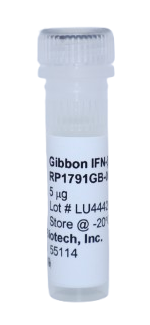
Gibbon IFN beta Recombinant Protein
- Catalog Number:
- RP1791GB
- Availability:
- In stock
- Application:
- Cell Culture, Control, ELISA, ELISpot Control, Western Blot Control
- 100% Homology:
- Nomascus leucogenys (northern white-cheeked gibbon)
 Powered by Bioz
 - Gibbon IFN-β (Interferon beta) (catalog RP1791GB) is a yeast-derived cytokine supplied lyophilized without carrier protein in 10% trehalose; it has no affinity tags and is naturally endotoxin-free, and should be reconstituted in sterile PBS that contains at least 0.1% carrier protein. The protein is ~20.1 kDa, 166 amino acids long (full sequence provided), and >98% pure by SDS-PAGE, with 100% amino-acid homology to northern white-cheeked gibbon. Store at -20°C (stable up to twelve months from date of receipt; working aliquots with carrier protein stable ~3 months) and avoid repeated freeze/thaw cycles. Product origin is the USA. It is commonly used to study IFN-β signaling and immune responses (including regulation of antiviral defense, innate immunity, and cytokine-mediated pathways); typical experimental uses include cell-culture stimulation and antiviral assays, cytokine signaling studies, ELISA and neutralization assays, flow-cytometry and Western blot controls, and antibody generation/validation. Kingfisher Biotech products are supplied for research applications and are not intended for medicinal, diagnostic, or therapeutic use.
| Amino Acid Sequence | MSYNLLGFLQ RRSSFQCQKL LWQLNGKLEY CLKDRMNFDI PEEIKQLQQF QKEDAALTIY EMLQNIFAVF RQDLSSTGWN ETIVENLLAN VYHQIDHLKT VLEEKLEKED FTRGKFMSSL HLKRYYGRIL HYLKAKEYSH CAWTVVRVEI LRNFFFINRL TGYLRN (166) |
| Endotoxin | Naturally endotoxin-free |
| Form | Lyophilized |
| Storage Conditions | -20°C |
| Molecular Weight | 20.1 kDa |
| Purity | >98% as visualized by SDS-PAGE analysis. |
| Expression System | Yeast |
| Form | Lyophilized |
| Country Of Origin | USA |
Gibbon Interferon-Beta (IFN-β) is a type I interferon produced by virus-infected epithelial cells, fibroblasts, macrophages, and dendritic cells in gibbons (family Hylobatidae), where it functions as a key early mediator of innate antiviral immunity. Highly conserved with human IFN-β due to close phylogenetic relatedness, gibbon IFN-β signals through the type I interferon receptor complex (IFNAR1/IFNAR2), activating JAK/STAT pathways and inducing interferon-stimulated genes (ISGs) that inhibit viral replication, enhance antigen presentation, and promote natural killer (NK) cell and adaptive immune responses. IFN-β plays an important role in host defense against viral pathogens documented in nonhuman primates, including hepatitis viruses, herpesviruses, respiratory viruses, and emerging zoonotic agents. As lesser apes with genetic and immunologic similarity to humans, gibbons provide valuable comparative insight into primate interferon biology, antiviral signaling, and host–virus co-evolution. Characterization of gibbon IFN-β supports research in primate infectious disease susceptibility, conservation medicine, and translational immunology, particularly in understanding species-specific differences in type I interferon regulation, immune activation, and viral pathogenesis relevant to human health.
Citations
Please choose a size to see price
RELATED MEDIA
