Slide 1 of 1 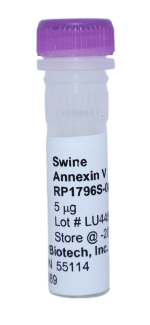
Swine Annexin V Recombinant Protein
- Catalog Number:
- RP1796S
- Availability:
- In stock
- Application:
- Cell Culture, Control, ELISA, ELISpot Control, Western Blot Control
- 100% Homology:
- Sus scrofa (pig)
 Powered by Bioz
 - Swine Annexin V (ANXV) (catalog RP1796E) is a yeast-derived phospholipid-binding protein supplied lyophilized without carrier protein in 10% trehalose; it has no affinity tags and is naturally endotoxin-free, and should be reconstituted in sterile PBS that contains at least 0.1% carrier protein. The protein is ~36.0 kDa, 321 amino acids long (full sequence provided), and >98% pure by SDS-PAGE, with 100% amino-acid homology to pig. Store at -20°C (stable up to twelve months from date of receipt; working aliquots with carrier protein stable ~3 months) and avoid repeated freeze/thaw cycles. Product origin is the USA. It is commonly used to study Annexin V function and cellular processes (including phosphatidylserine binding, apoptosis detection, and membrane-related events); typical experimental uses include apoptosis assays (e.g., Annexin V staining), cell-based binding assays, signaling studies, flow-cytometry and Western blot controls, and antibody generation/validation. Kingfisher Biotech products are supplied for research applications and are not intended for medicinal, diagnostic, or therapeutic use.
| Amino Acid Sequence | MAQVLRGTVT DFPGFDERAD AETLRKAMKG LGTDEESILT LLTSRSNAQR QEIAVAFKTL FGRDLLDDLK SELTGKFEKL IVALMKPSRL YDAYELKHAL KGAGTDEKIL TEIIASRTPE ELRAIKQVYE EEYGSSLEDD VVGDTSGYYQ RMLVVLLQAN RDPDGRIDEA QVEQDAQALF QAGELKWGTD EEKFITILGT RSVSHLRRVF DKYMTISGFQ IEETIDRETS GNLEQLLLAV VKSIRSIPAY LAETLYYAMK GAGTDDHTLI RVMVSRSEID LFNIRKEFRK NFATSLYSMI KGDTSGDYKK ALLLLCGGED D (321) |
| Endotoxin | Naturally endotoxin-free |
| Form | Lyophilized |
| Storage Conditions | -20°C |
| Molecular Weight | 36.0 kDa |
| Purity | >98% as visualized by SDS-PAGE analysis. |
| Expression System | Yeast |
| Form | Lyophilized |
| Country Of Origin | USA |
Swine Annexin V (also known as ANXA5, Annexin A5, placental anticoagulant protein I (PAP-I), lipocortin V, or anchorin CII) is a calcium-dependent phospholipid-binding protein belonging to the annexin family, which plays important roles in membrane organization, cellular signaling, inflammation, and regulation of apoptosis. In pigs (Sus scrofa domesticus), Annexin V binds with high affinity to phosphatidylserine exposed on the outer leaflet of the plasma membrane during early stages of apoptosis or cellular injury in the presence of calcium ions. Because of this property, FITC-labeled swine Annexin V (Annexin V–FITC) is widely used in flow cytometry and fluorescence microscopy assays to detect and quantify apoptotic cells. Conjugation with fluorescein isothiocyanate (FITC) enables fluorescent labeling of cells displaying externalized phosphatidylserine, allowing sensitive identification of early apoptotic cells, typically used alongside viability dyes such as propidium iodide (PI) or 7-AAD to distinguish early apoptosis from late apoptosis or necrosis. In swine health and research, Annexin V–FITC assays are used to study immune cell apoptosis during viral infections such as porcine reproductive and respiratory syndrome virus (PRRSV) and swine influenza, as well as to evaluate inflammatory responses, tissue injury, and drug-induced cytotoxicity. It is also applied in reproductive biology to assess sperm membrane integrity and early embryonic cell viability in assisted reproductive technologies. As a biomarker of apoptosis and membrane remodeling, swine Annexin V supports veterinary and translational research into host–pathogen interactions, immune regulation, and cell death pathways relevant to both livestock health and human disease models.
Citations
Please choose a size to see price
RELATED MEDIA
