Slide 1 of 1 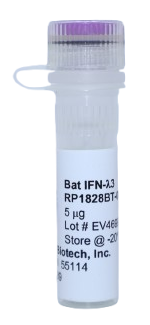
Common Vampire Bat IFN lambda 3 (IL-28B) Recombinant Protein
- Catalog Number:
- RP1828BT
- Availability:
- In stock
- Application:
- Cell Culture, Control, ELISA, ELISpot Control, Western Blot Control
- 100% Homology:
- Desmodus rotundus (common vampire bat) [H145R][V214I]
 Powered by Bioz
 - Bat IFN-λ3 (Interferon lambda 3, IL-28B) (catalog RP1828BT) is a yeast-derived cytokine supplied lyophilized without carrier protein in 10% trehalose; it has no affinity tags and is naturally endotoxin-free, and should be reconstituted in sterile PBS that contains at least 0.1% carrier protein. The protein is ~23.4 kDa, 214 amino acids long (full sequence provided), and >98% pure by SDS-PAGE, with 100% amino-acid homology to common vampire bat. Store at -20°C (stable up to twelve months from date of receipt; working aliquots with carrier protein stable ~3 months) and avoid repeated freeze/thaw cycles. Product origin is the USA. It is commonly used to study IFN-λ3 signaling and immune responses (including regulation of antiviral defense at epithelial barriers, innate immunity, and cytokine-mediated pathways); typical experimental uses include cell-culture stimulation and antiviral assays, cytokine signaling studies, ELISA and neutralization assays, flow-cytometry and Western blot controls, and antibody generation/validation. Kingfisher Biotech products are supplied for research applications and are not intended for medicinal, diagnostic, or therapeutic use.
| Amino Acid Sequence | PPPLLTLSMP SLVSPSINTD LPVGCTLVLM LMTTVLTRTA AVPVPTPLSA LPGARGCVVA QFKFLAPQDM KAFRRAKDTL EELLLPKNRS CSSRPFPRTR DLRQLQVWER PVALEAELAL TLKVLGSIAN STLGDILDQP LHMLRYIHTK LQACVPAQAT AGPRPRGHLH HWLHRLQEAS KKESTGCLEA SVTFNLFRLL THDLQCVASG GLCI (214) |
| Endotoxin | Naturally endotoxin-free |
| Form | Lyophilized |
| Storage Conditions | -20°C |
| Molecular Weight | 23.4 kDa |
| Purity | >98% as visualized by SDS-PAGE analysis. |
| Expression System | Yeast |
| Form | Lyophilized |
| Country Of Origin | USA |
Vampire bat interferon lambda 3 (IFN-λ3), also known as interleukin-28B (IL-28B), is a member of the type III interferon family (IFN-λ1/IL-29, IFN-λ2/IL-28A, IFN-λ3/IL-28B, and IFN-λ4) and functions as a critical antiviral cytokine that signals through the heterodimeric IFNLR1 (IL-28Rα)/IL-10R2 receptor complex, activating JAK/STAT pathways and inducing interferon-stimulated genes (ISGs) that restrict viral replication at epithelial surfaces. In vampire bats (Desmodus rotundus), recognized reservoirs for zoonotic viruses including rabies virus and other RNA viruses, IFN-λ3 is expected to play a central role in mucosal antiviral defense within the respiratory and gastrointestinal tracts while limiting excessive systemic inflammation. Because type III interferons primarily act on epithelial cells and generate a more localized antiviral response compared to type I interferons, IFN-λ3 may contribute to bats’ notable ability to tolerate viral infections without overt pathology. Characterizing vampire bat IFN-λ3 (IL-28B) provides important insight into mechanisms of viral control, immune modulation, and host–pathogen equilibrium, informing both wildlife disease management and broader research into antiviral immunity and zoonotic spillover risk.
Citations
Please choose a size to see price
RELATED MEDIA
