Slide 1 of 1 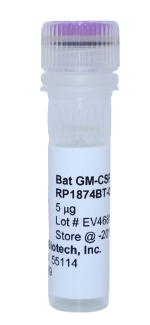
Jamaican fruit-eating Bat GM-CSF Recombinant Protein
- Catalog Number:
- RP1874BT
- Availability:
- In stock
- Application:
- Cell Culture, Control, ELISA, ELISpot Control, Western Blot Control
- 100% Homology:
- Artibeus jamaicensis (Jamaican fruit-eating bat)
 Powered by Bioz
 - Bat GM-CSF (Granulocyte-Macrophage Colony-Stimulating Factor) (catalog RP1874BT) is a yeast-derived cytokine supplied lyophilized without carrier protein in 10% trehalose; it has no affinity tags and is naturally endotoxin-free, and should be reconstituted in sterile PBS that contains at least 0.1% carrier protein. The protein is ~14.3 kDa, 126 amino acids long (full sequence provided), and >98% pure by SDS-PAGE, with 100% amino-acid homology to Jamaican fruit-eating bat (with noted substitution P(123)T). Store at -20°C (stable up to twelve months from date of receipt; working aliquots with carrier protein stable ~3 months) and avoid repeated freeze/thaw cycles. Product origin is the USA. It is commonly used to study GM-CSF signaling and immune responses (including regulation of granulocyte and macrophage proliferation, differentiation, and activation); typical experimental uses include cell-culture stimulation and proliferation assays, hematopoietic and cytokine signaling studies, ELISA and neutralization assays, flow-cytometry and Western blot controls, and antibody generation/validation. Kingfisher Biotech products are supplied for research applications and are not intended for medicinal, diagnostic, or therapeutic use.
| Amino Acid Sequence | APIHPPSLVT RHFVHVDTIK EALTLLNTSD ITEVMNETVE VVSETFDPKE PTCLQTRLEL YQQGLRGNLT ILEGPLTLMA QHYGQHCPPT PETSCATQIT TFKNFKENLN NFLLIIPFDC WSTIQE (126) P(123)T |
| Endotoxin | Naturally endotoxin-free |
| Form | Lyophilized |
| Storage Conditions | -20°C |
| Molecular Weight | 14.3 kDa |
| Purity | >98% as visualized by SDS-PAGE analysis. |
| Expression System | Yeast |
| Form | Lyophilized |
| Country Of Origin | USA |
Jamaican Fruit-eating Bat GM-CSF (Granulocyte–Macrophage Colony-Stimulating Factor, CSF2) is a hematopoietic cytokine belonging to the colony-stimulating factor family, which also includes G-CSF (CSF3) and M-CSF (CSF1) that regulate the development, differentiation, and activation of myeloid immune cells. In the Jamaican fruit-eating bat (Artibeus jamaicensis), GM-CSF is likely produced by activated T lymphocytes, macrophages, endothelial cells, and fibroblasts in response to infection, inflammatory cytokines, or immune stimulation. GM-CSF binds to the GM-CSF receptor (CSF2R) on hematopoietic progenitor cells and mature myeloid cells, activating intracellular signaling pathways such as JAK/STAT, MAPK/ERK, and PI3K–AKT, which promote the proliferation, differentiation, and activation of granulocytes, macrophages, and dendritic cells. In bats, GM-CSF likely contributes to regulation of innate immune responses and development of antigen-presenting cells, which are important for coordinating antiviral immunity and immune homeostasis. Because bats serve as natural reservoirs for several zoonotic viruses, including coronaviruses and other emerging pathogens, studying cytokines such as GM-CSF in species like the Jamaican fruit-eating bat helps researchers understand myeloid cell development, inflammatory regulation, and host–pathogen interactions in bat immune systems, providing insights into how bats tolerate viral infections while limiting excessive inflammatory damage.
Citations
Please choose a size to see price
RELATED MEDIA
